



How to Sign Up for Meta Muse and Use a Referral Code
Muse has recently become one of the most talked-about AI Agent products in the AI tools space. As a new AI Agent from …
Explore the 2026 YouTube creator outlook: learn why stable publishing, Shorts discovery, and AI integration are essential for channel growth and how to manage multiple accounts at scale.

Get an AI-Powered Summary of This Article
2026 has become a noticeably different year for YouTube creators. Many channels are still publishing regularly, but views are uneven, Shorts bring traffic without always bringing subscribers, and some channels remain difficult to scale even when the content itself is solid.In many cases, the issue is not the video itself, but the operating logic behind it.
YouTube’s latest creator outlook makes the direction clearer: creators are increasingly treated as studios, Shorts remains a major discovery surface, brand partnership tools continue to expand, and AI is becoming more deeply embedded in creation and content governance.
From an operations perspective, the main trend is easy to summarize:
Once this direction is clear, it becomes much easier to understand why some YouTube videos keep growing while others stall.
For a long time, YouTube growth was often treated as a simple formula: publish a YouTube video, wait for recommendations, and check the results. That logic is no longer enough in 2026. YouTube’s annual creator update makes it clear that creators are increasingly operating like studios, not just uploaders.
The platform now spans long-form video, YouTube Shorts, music videos, livestreams, and podcasts, and it is continuing to build around that broader content ecosystem.
That shift has practical consequences. Content is no longer just a single upload; it is part of a repeatable publishing structure. A channel is no longer just a collection of videos; it is a content brand with a defined topic, audience, and rhythm. In other words, viewers are no longer only reacting to one YouTube video at a time. They are deciding whether the channel can continue delivering value over time.

This is an inference from YouTube’s “creator as studio” direction and its emphasis on series, playlists, and multi-format consumption.
Operational suggestion:
Many creators still assume that more views automatically mean more income. In 2026, that is no longer a safe assumption. YouTube has continued expanding monetization pathways through brand partnerships, shopping, fan support, and content-to-commerce connections.
The platform says it has paid more than $100 billion to creators, artists, and media companies over the past four years, and its YouTube Creator Partnerships system is now being integrated more deeply into YouTube Studio and Google’s ad systems.
The logic behind this shift is straightforward: YouTube is no longer only looking at how much traffic a creator can generate. It is also looking at whether that creator has real influence. Broad entertainment content may still get more views, but highly focused content often converts better.
For channels built around tutorials, tools, product reviews, and niche expertise, that usually means stronger monetization potential even if the raw reach is smaller. YouTube’s own partnership tools are increasingly built around audience overlap, brand relevance, and creator credibility.
Operational suggestion:
A common question in 2026 is whether Shorts is still worth doing. The answer is yes, and in many cases, it is more important than before. YouTube says Shorts continues to be a major discovery surface, and its creator update shows that Shorts remains a central part of how audiences find new channels. The format now functions less as a standalone traffic hack and more as a discovery layer within the broader YouTube system.
The more important change is how Shorts is evaluated. It is no longer just about raw views. YouTube and third-party analysis both point toward satisfaction signals, including completion, watch time, and follow-up behavior. For short-form content, that means whether viewers stay through the clip, whether they continue to other videos, and whether they subscribe after watching.
YouTube’s recommendation system is increasingly designed to reward content that keeps users engaged, not simply content that gets clicked once.
From an operations perspective, a short clip can now serve as the front end of a larger funnel. A YouTube Shorts clip can introduce the topic, a long YouTube video can build trust, and a playlist or channel page can support deeper viewing. In that sense, Shorts is not replacing long-form content; it is helping channels build a discovery path into it.
Operational suggestion:
By 2026, AI is no longer a side tool in content production. It is part of the basic infrastructure. Creators are using AI to draft scripts, edit clips, generate captions, and analyze drop-off points. YouTube’s creator update also makes it clear that the platform is expanding AI creation tools while at the same time tightening transparency and quality rules around synthetic content.
At the same time, YouTube has made its policy position clear: AI can be used, but it cannot be abused. Realistic altered or synthetic content must be disclosed, and harmful synthetic media can be removed. AI can assist with research and structure, but content still needs to be helpful, original, and people-first.
That means the most reliable strategy is not “publish more,” but “publish more clearly, more consistently, and with more value.” In other words, AI is most effective when it increases speed and clarity, not when it replaces judgment.
Operational suggestion:
Whether the workflow is multi-direction testing, Shorts distribution, or AI-assisted production, one thing becomes unavoidable: the execution layer matters. Once a creator starts managing multiple YouTube accounts or testing content at scale, the main bottlenecks are usually not content ideas. They are account separation, repeat operations, publishing consistency, and workflow stability.
A few common problems appear again and again:
If several YouTube accounts are logged in from the same device or network environment, they may appear more closely linked than intended.
repetitive work takes time switching between accounts, publishing videos, distributing Shorts, and handling comments manually is difficult to sustain over the long term.
If different accounts run in different devices or networks, it becomes harder to tell whether a result comes from the content itself or from the environment.
Even when one content strategy works, it is often hard to replicate it consistently across multiple channels or accounts without a stable execution system.
These problems point to one simple question: how can a content strategy that already works be executed consistently, safely, and at scale?
YouTube operations can be understood in three layers:
Most creators focus only on the content layer, but environment and process layer are what keep a YouTube account running consistently over time.
When you begin operating multiple YouTube accounts and running batch content tests, maintaining stable account environments and manually uploading content become extremely challenging. As a result, more and more creators are turning to anti-association tools like DuoPlus Cloud Phone for account management:
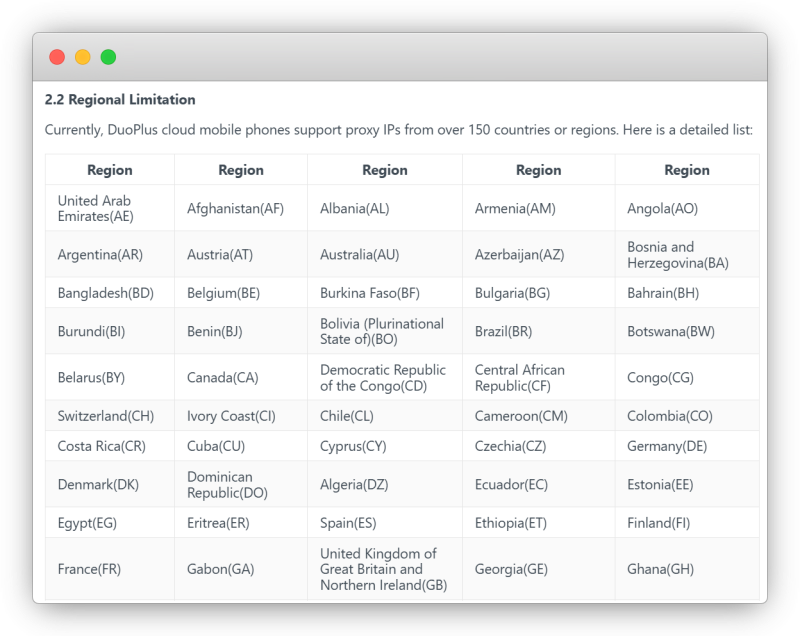
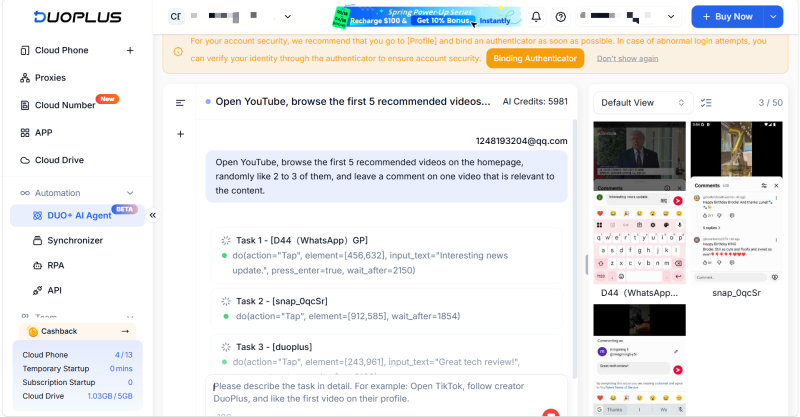
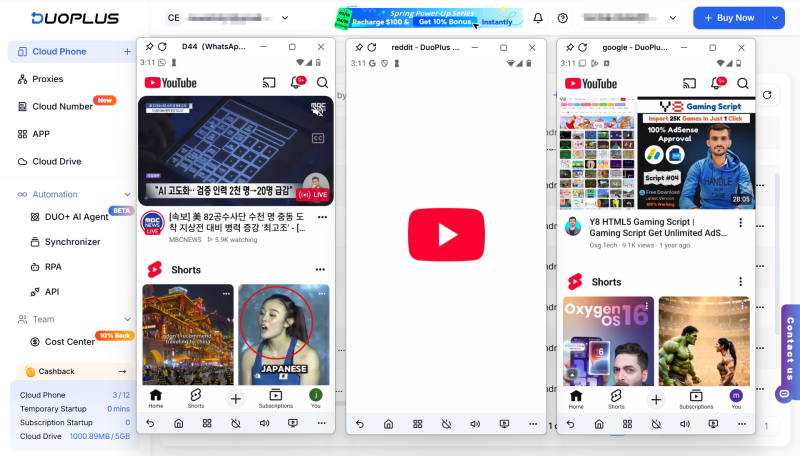
With DuoPlus Cloud Phone, you can continuously scale your proven YouTube content strategies. Backed by stable environments and automated execution, you can minimize manual work and accelerate growth efficiency.
The 2026 YouTube landscape is no longer defined by who can create a single strong video. It is defined by who can keep producing effective content, who can drive discovery through Shorts, who can monetize across multiple revenue streams, and who can execute consistently across multiple accounts and workflows.
In this environment, AI accelerates production speed, Shorts boosts discoverability, and cloud-based execution enhances stability. When these three elements work in tandem, content growth becomes far easier to replicate.
For creators and teams managing multiple YouTube accounts, this is often the difference between a temporary spike and a truly scalable growth system.
Muse has recently become one of the most talked-about AI Agent products in the AI tools space. As a new AI Agent from …

OpenAI Codex is an AI coding agent designed to help developers write, modify, review, and deliver code. It is available …
VK (VKontakte) is one of the major social media platforms in Russia. In addition to account management, content …
No need to purchase multiple real phones.
With DuoPlus, one person can operate numerous cloud phones and social media accounts from a single computer, driving traffic and boosting sales for you.