




How to Log In to Codex: What to Do If You Don't Receive the Phone Verification Code
OpenAI Codex is an AI coding agent designed to help developers write, modify, review, and deliver code. It is available …
Learn what a residential proxy is, how residential IPs work, their key benefits and use cases, and how to configure a residential proxy on DuoPlus Cloud Phone.

Get an AI-Powered Summary of This Article
In cross-border e-commerce, overseas social media operations, and data collection, an IP address not only determines where a device appears to be accessing the internet from, but can also influence how some websites evaluate the source of a request. For businesses that require a specific regional network environment, residential proxies are a common option.
However, residential proxies are not necessary for every scenario. Their value becomes more apparent when a business has specific requirements for IP location, network source, or access stability. This article explains how residential proxies work, their key benefits and use cases, and how to use a residential proxy with DuoPlus Cloud Phone.
A residential proxy is a proxy service that provides IP addresses through real residential networks. When a user connects to a residential proxy, network requests are first routed through a proxy server and then sent to the target website through the corresponding residential IP.
Instead of seeing the public IP currently used by the user's device, the target website sees the residential IP provided by the proxy service. This allows residential proxies to change the apparent location of network access and provide specific regional network environments for different business scenarios.
Residential proxies are typically available based on criteria such as country, city, and even ISP. For example, if you need to test how a website appears to users in the United States, you can select a US residential IP. If you need to check Google search results in the UK, you can use a UK residential IP.
It is important to note that a residential IP does not guarantee absolute safety or prevent platform verification. Websites and platforms may also evaluate account behavior, device information, cookies, and other network characteristics. Therefore, a residential proxy alone cannot solve account or platform risk-control issues.
A residential IP is a public IP address assigned by an internet service provider (ISP) to a residential network, such as a home broadband or mobile network. Because these IPs originate from real residential networks, they can reflect information associated with a particular location and network provider.
A residential proxy uses these residential IPs as network exits. Users do not directly connect to the residential network where the IP is located. Instead, their requests are forwarded through a proxy server, which accesses the target website using the corresponding residential IP.
The process can be simplified as:
User device → Residential proxy server → Residential IP → Target website
For example, suppose you need to access a website that displays specific content to users in the United States. After selecting a US residential proxy, your request is first sent to the proxy provider. The provider then sends the request through the selected US residential IP.
When the target website receives the request, it identifies the US residential IP and can return content based on that location.
Residential IPs originate from real residential networks and therefore generally resemble the network sources used by ordinary users more closely when IP types are evaluated.
Using a residential IP as the network exit can reduce some issues caused by an unusual IP type, such as frequent CAPTCHA challenges, additional login verification, content restrictions, or account security alerts.
However, this does not mean residential IPs eliminate platform risk. Account behavior, device information, and other factors can still affect how a platform evaluates an account.
Residential proxies can support different operating requirements through static and rotating IP allocation.
The appropriate option depends on the actual business requirement. A stable IP is more suitable when maintaining a consistent network environment is important, while rotating IPs can provide greater flexibility for location-based research and testing.
Many regional content distribution systems, localized search results, and location-based advertising experiences are designed around local user access patterns.
Because residential IPs are associated with residential networks and specific geographic locations, they can provide results that are closer to what users in the corresponding market may see.
For example, residential proxies can be used to test short-form video content across different countries, check local Google search results, preview overseas advertising landing pages, or monitor competitor pricing.
Residential proxies are particularly suitable for businesses with specific requirements related to location, IP source, or network environment.
Cross-border sellers can use residential IPs from different locations to access target markets and check local search results, product pages, and pricing information.
For example, when operating in the US market, a US residential IP can be used to check the content displayed to users in that market and reduce information differences caused by accessing the website from another location.
If an overseas social media account requires a network environment associated with a particular region, a residential proxy can be combined with the corresponding device environment to keep the network exit aligned with the target market.
However, residential proxies only address the network exit. Account behavior must still comply with the platform's policies.
Advertising and website teams can use residential IPs from different locations to test websites, advertising landing pages, and localized content.
These scenarios often require IP resources from multiple regions, making residential proxies more flexible than relying on a single fixed network location.
Some public websites return different information depending on the visitor's location. For cross-regional price monitoring, search-result analysis, or public data collection, residential IPs can be selected according to the target market.
If you are simply browsing ordinary websites and there are no location restrictions or specific IP requirements, there is no need to use a residential proxy solely for the sake of using one. Whether you need a residential proxy mainly depends on whether your business actually requires a residential network environment from a specific location.
When a residential proxy is used with mobile applications such as TikTok, Instagram, or Google Play, configuring the proxy alone does not provide a complete mobile device environment.
You can instead configure the proxy on the corresponding DuoPlus Cloud Phone so that the cloud phone accesses the internet through the specified residential IP.
DuoPlus supports custom proxy configuration. Users can enter the proxy IP, port, username, password, and other parameters provided by their proxy provider and assign the proxy to the corresponding cloud phone.
The basic process is as follows:
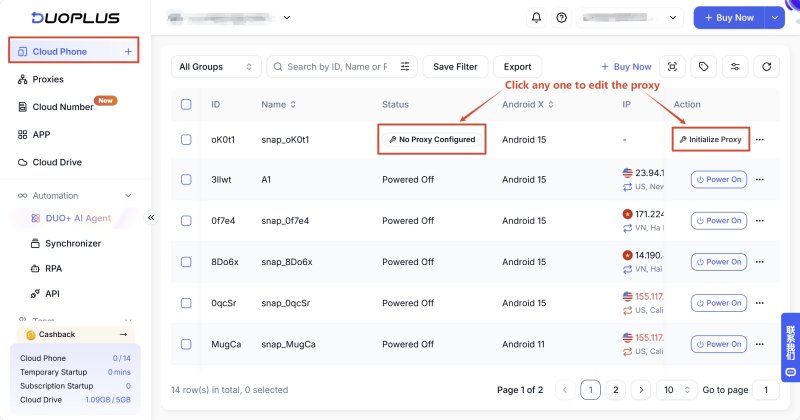
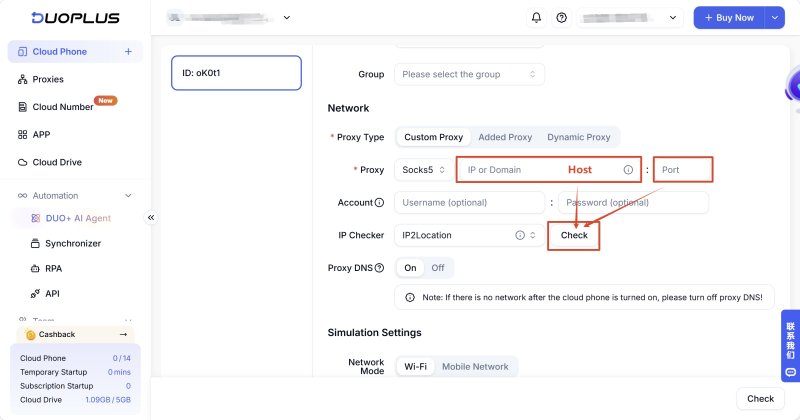
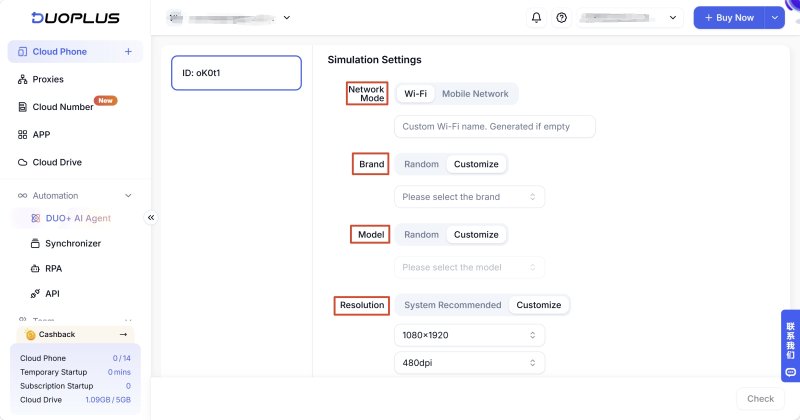
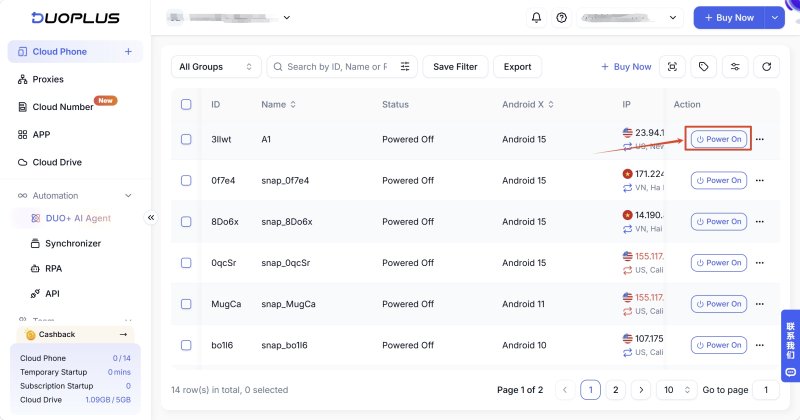
If you operate multiple overseas accounts, you can also configure residential proxies based on the target market of each account. For example, a US-market account can use a US residential IP, while a UK-market account can use a UK residential IP, keeping the network environment aligned with the target market.
The exact configuration method depends on the protocol provided by the proxy service. Before configuring the proxy, confirm the proxy type, server address, port, and authentication method. It is also recommended to test the proxy connection before using it for actual operations.
The core value of a residential proxy is providing an IP exit from a residential network. It is more suitable for cross-border businesses with specific requirements for IP source, network environment, or geographic location, including overseas account operations, market research, and regional content testing.
If you are simply accessing ordinary websites without specific location or IP-type requirements, there is generally no need to use a residential proxy. For users who need to operate overseas mobile accounts over the long term, residential proxies can be combined with DuoPlus Cloud Phone to manage the device environment and network exit together.
Not necessarily. If an account needs a relatively stable network exit, a static residential IP may be more suitable. For market research and regional testing, rotating IPs may be more appropriate depending on the specific requirements.
It is technically possible in many cases, but whether this is appropriate depends on the specific business scenario. If multiple accounts need separate network environments, configuring different proxy IPs for each account can make account and network management easier.
The two solve different problems. A residential proxy provides the network exit, while a cloud phone provides the mobile device environment. If you need to manage multiple overseas mobile app accounts, they can be used together.
Yes. DuoPlus supports custom proxy configuration. You can enter the residential proxy address, port, and authentication information on a cloud phone so that it accesses overseas apps and websites through the specified residential IP.
OpenAI Codex is an AI coding agent designed to help developers write, modify, review, and deliver code. It is available …

VK (VKontakte) is one of the major social media platforms in Russia. In addition to account management, content …

ChatGPT is available through both the web version and desktop/mobile apps. The web version requires no installation and …
No need to purchase multiple real phones.
With DuoPlus, one person can operate numerous cloud phones and social media accounts from a single computer, driving traffic and boosting sales for you.