




How to Sign Up for Meta Muse and Use a Referral Code
Muse has recently become one of the most talked-about AI Agent products in the AI tools space. As a new AI Agent from …
Learn what dynamic proxy IPs are, how they work, how they differ from rotating proxies, and when to use them. This guide also covers how to choose a dynamic proxy IP and configure it on DuoPlus Cloud Phone.

Get an AI-Powered Summary of This Article
As demand grows for data collection, cross-border business, and multi-region network access, proxy IPs have become a common tool for many online operations. Compared with using the same IP for an extended period, some tasks require the network exit IP to change based on time, request volume, or target location. This is where dynamic proxy IPs can be useful.
However, a dynamic proxy IP does not necessarily mean that every proxy service automatically changes its IP. The IP source, rotation frequency, switching mechanism, and level of control can all affect how well a proxy fits a particular use case.
This guide explains what dynamic proxy IPs are, how they work, how they differ from rotating proxies, where they can be used, and how to choose and configure one on DuoPlus Cloud Phone.
A dynamic proxy IP is a proxy service that can change its exit IP address while in use. Instead of connecting directly to a target website, your network request is first sent to a proxy server, which then accesses the target service using the assigned IP.
For example, a request may initially use IP A. After a certain period or when a specified condition is met, subsequent requests may be routed through IP B. From the target website's perspective, the requests are coming from different exit IPs.
The key feature of a dynamic proxy IP is that the proxy IP can change over time. Exactly when and how it changes depends on the proxy provider's rotation mechanism.
A typical dynamic proxy process involves three basic steps:
The basic process can be represented as:
User Device → Proxy Server → Exit IP → Target Website
Dynamic proxy IPs are commonly used when a business needs to change its network exit or access content from different regions.
Dynamic proxy IP is a broader concept that emphasizes that the IP can change, while a rotating proxy focuses more specifically on changing IPs according to a defined mechanism. The two concepts are not completely equivalent, and a rotating proxy can be considered one implementation of a dynamic proxy IP.
For example, if a proxy IP changes after being used for a certain period, it can be described as a dynamic proxy IP. If the provider specifies a rule such as "change the IP every 30 minutes" or "change the IP after every request," this represents a more clearly defined rotation mechanism.
| Comparison | Dynamic Proxy IP | Rotating Proxy |
|---|---|---|
| Definition | IP can change | IP changes according to specific rules |
| Main focus | Whether the IP is fixed | When and how the IP changes |
| Rotation mechanism | Determined by the provider | Usually has defined rotation rules |
| Relationship | Broader concept | One implementation of dynamic IP |
Therefore, you do not need to focus too much on whether a service is called a "dynamic proxy" or a "rotating proxy." Instead, check how the IP actually changes. If your business requires IP changes at fixed intervals, after a certain number of requests, or under specific conditions, make sure the provider supports the required rotation mechanism.
Dynamic IP changes usually happen on the proxy server side, rather than on the user's device.
A proxy provider typically maintains a pool of available IP resources. When a request is received, the system selects an appropriate exit IP according to its configured rules. Once the rotation condition is met, subsequent requests can be assigned a different IP.
| Time | Exit IP | Status |
|---|---|---|
| 10:00 | IP A | Initial IP |
| 10:05 | IP A | Rotation condition not met |
| 10:10 | IP B | IP rotation triggered |
| 10:15 | IP B | Current IP remains active |
| 10:20 | IP C | IP rotation triggered again |
The actual rotation interval varies between providers. Some services rotate IPs based on time, some based on request volume, while others allow users to obtain a new IP through an API or by establishing a new connection.
Before using a dynamic proxy, make sure you understand the provider's specific rotation mechanism. Otherwise, the service may not meet your actual IP rotation requirements.
Dynamic proxy IPs are not a universal solution for every network task. Whether they are appropriate depends mainly on whether your business needs to change its exit IP and whether changing the IP could affect accounts, sessions, or access status.
For tasks that involve accessing large amounts of publicly available web content, concentrating requests through a single IP for an extended period may result in access restrictions.
Dynamic proxy IPs can distribute requests across different proxy IPs according to predefined rules. However, users should still follow the target website's robots rules, terms of service, and access restrictions. Changing IPs should not be used as a way to bypass access controls.
Cross-border businesses often need to view web content, test websites, or perform localization checks from different countries and regions.
Dynamic proxy IPs can provide exit IPs from different locations. For example, if you need to test how a website appears in the US, UK, and Germany, you can select proxy IPs from the corresponding regions.
In these scenarios, IP location accuracy is just as important as the size of the IP pool.
Some tasks do not require a new IP for every request but instead need to change the IP after a certain period.
For example, a data task running for several hours could use one IP for a set period and switch to another once the rotation condition is reached.
This is easier to manage than changing IPs randomly and can be more suitable for tasks that also require relatively stable network connections.
When choosing a dynamic proxy IP, do not focus only on the number of IPs and the price. The IP source, rotation method, and stability can vary significantly between providers.
First, determine how the provider changes IPs.
If your business requires IP rotation at fixed intervals, look for a service that supports time-based rotation. If you need to change IPs based on request volume, confirm whether the provider supports request-based rotation.
You should also check whether each rotation guarantees a new IP and whether the new IP may come from the same IP range.
The IP source directly affects the characteristics of the proxy.
If your business needs a residential network environment, residential proxies may be more appropriate. If the proxy is mainly used for server access, automated tasks, or basic network connections, data center proxies may be sufficient.
Location should also match the actual business requirements. For overseas market testing, check whether the provider covers the target countries, cities, or even specific carriers.
Dynamic proxy IPs may involve frequent connection changes, so proxy server stability can directly affect task execution.
When evaluating a provider, consider:
A lower price does not necessarily mean a lower overall cost. If proxy IPs frequently fail, repeated retries can consume more time and traffic.
Dynamic proxy IPs can change the IP used by mobile applications, but apps such as TikTok and Instagram may also evaluate the device environment when assessing account activity. Changing the IP alone does not create a complete or stable operating environment.
For scenarios that require separate device environments, you can configure the dynamic proxy IP on DuoPlus Cloud Phone and use the proxy together with an independent cloud phone environment.
Prepare the proxy address, port, username, and password provided by your proxy service, then add them through the proxy settings in DuoPlus.
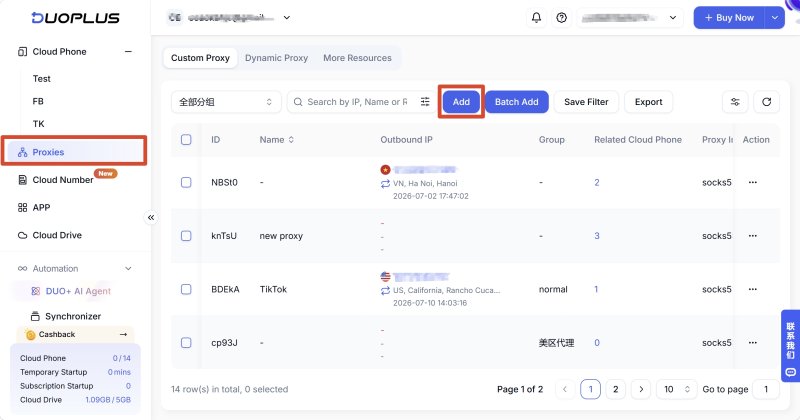
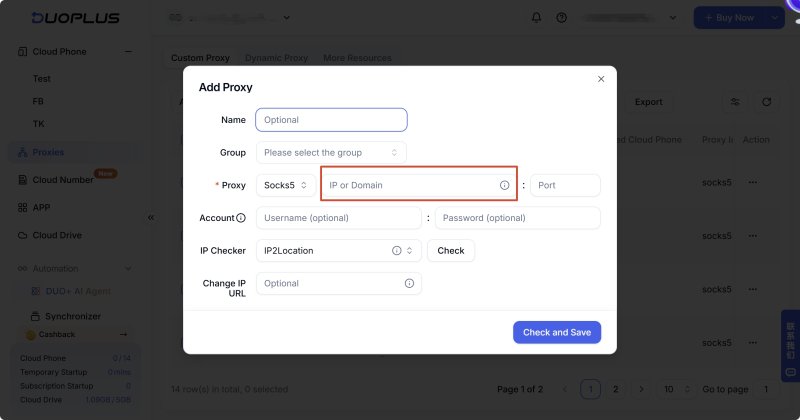
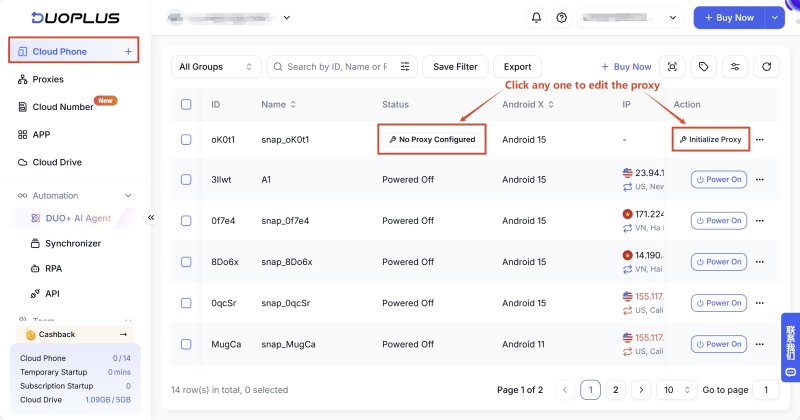
After adding the proxy, assign it to the corresponding cloud phone environment. Different cloud phones can use different proxies according to your requirements, while IP rotation is handled according to the provider's rules.
Assign the Proxy to a new Cloud Phone:
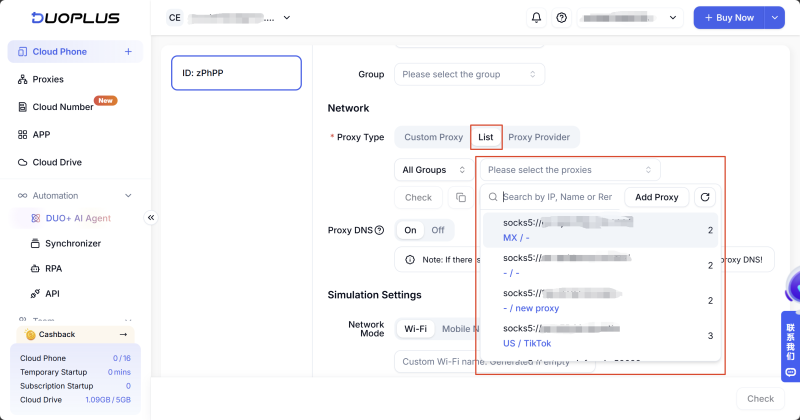
Assign the Proxy to a uesd Cloud Phone:
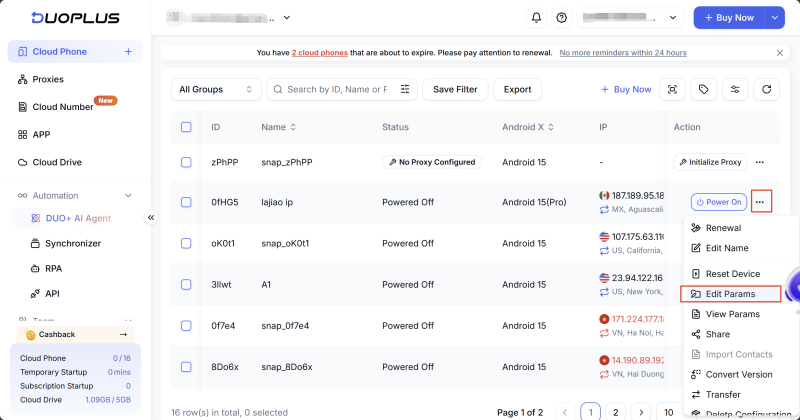
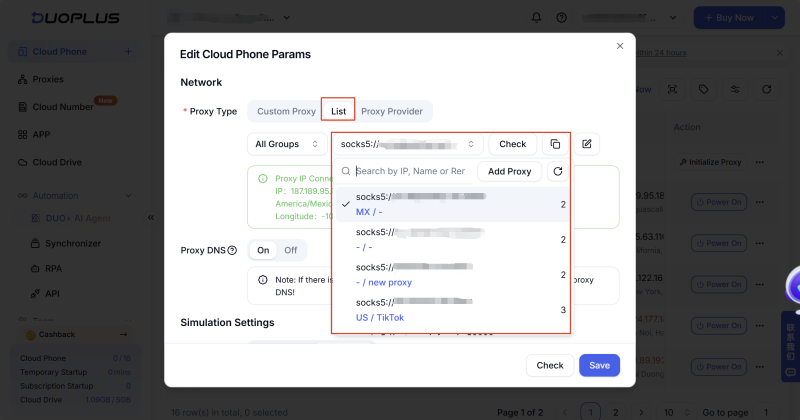
Once the configuration is complete, you can use an IP detection service to check the current exit IP and location. If the proxy supports IP rotation, check again after the IP changes to confirm that the new IP is active.
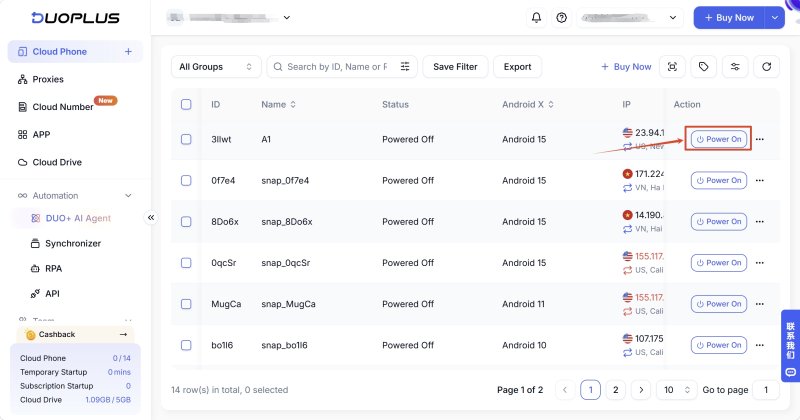
One thing to keep in mind is that an IP change does not automatically change every other part of the network environment. For example, after the IP location changes, the device language, time zone, and app settings may remain unchanged. If you need to perform a complete regional environment test, check these settings according to your specific requirements rather than relying on the IP address alone.
The main feature of a dynamic proxy IP is its ability to change the network exit IP during use. It can be useful for IP rotation, multi-region access, and long-running network tasks.
Dynamic proxy IPs and rotating proxies often overlap in practical use, so the most important thing when choosing a service is to understand its actual IP rotation mechanism rather than relying only on the product name.
If you need a dynamic IP, consider the IP source, location coverage, rotation method, stability, and cost. For mobile applications that require a dedicated device environment, you can combine a proxy service with DuoPlus Cloud Phone to manage different network configurations while letting the proxy service handle IP rotation.
A dynamic proxy IP can change its exit IP during use, while a static proxy generally keeps the same IP for an extended period. Businesses that require a stable, fixed IP are usually better suited to static proxies, while tasks that require periodic IP changes may benefit from dynamic proxies.
It depends on the provider's rotation mechanism. Some dynamic proxies rotate IPs based on time, some based on request volume, while others allow users to trigger an IP change through an API.
Dynamic proxy IPs can be useful for businesses that require different network exits. However, multi-account operations also involve account activity, device environments, and platform policies. Changing IPs alone cannot solve all account association or risk-control issues.
Yes. As long as the proxy provider offers a compatible proxy protocol and connection information, the proxy can be configured on the corresponding cloud phone. After configuration, IP rotation is generally handled by the proxy provider.
Muse has recently become one of the most talked-about AI Agent products in the AI tools space. As a new AI Agent from …

OpenAI Codex is an AI coding agent designed to help developers write, modify, review, and deliver code. It is available …

VK (VKontakte) is one of the major social media platforms in Russia. In addition to account management, content …
No need to purchase multiple real phones.
With DuoPlus, one person can operate numerous cloud phones and social media accounts from a single computer, driving traffic and boosting sales for you.