


How to Manage Multiple Social Media Accounts with DuoPlus Cloud Phone: A Guide to Device Names, Tags, and Groups
As TikTok, Instagram, and Facebook become important channels for brand marketing, content creation, and affiliate …
In 2026, eSIM activation is becoming more difficult. This article compares physical SIM cards, MVNO eSIMs, and cloud numbers—analyzing their stability and use cases to help you choose the right US phone number for managing multiple online accounts.

Get an AI-Powered Summary of This Article
In 2026, more and more users need a reliable US phone number that can be used long-term to receive verification codes, bind accounts, and maintain various online services. Whether you're registering for AI accounts like Claude or ChatGPT, or managing other global platforms, a stable, compliant overseas number is almost essential.
At the same time, the barriers to obtaining physical SIM cards and eSIMs are rising—cross-border shipping restrictions and increased difficulty of remote activation are making once‑convenient options less smooth. This article introduces three main types of online number solutions: physical SIM cards, eSIMs, and DuoPlus Cloud Numbers, for your reference.
In 2026, the barriers to obtaining a US number have risen across the board. For physical SIM cards, the main obstacle is logistics. US carriers have tightened cross‑border direct mail policies. Users typically need to use third‑party purchasing agents or overseas forwarding, which means long waiting times and unreliable delivery. After receiving the card, you need multiple physical phones to manage multiple SIM cards, making large‑scale use costly.
eSIMs were originally seen as a convenient way to bypass physical hardware, but the activation experience is deteriorating rapidly, mainly in four areas:
To combat cross‑border telecom fraud, carriers worldwide have raised the bar for online number activation. They now commonly require passport verification, facial recognition, and local payment card restrictions. For example, US carrier Visible checks the issuing bank of your payment card; if you use a card from a non‑US bank or your IP shows you are abroad, the order is automatically blocked.
Not all phones support overseas eSIMs. Some regional phone versions lack the necessary hardware, while others purchased from overseas markets may be carrier‑locked, meaning the number is tied to the device’s motherboard. Until unlocked, you cannot write another carrier’s profile.
Some carriers require that your network environment match the number’s home region during eSIM activation. If your Wi‑Fi connection experiences even brief instability or if your proxy nodes switch frequently, data transmission may break. Once activation fails, the original activation credential (e.g., QR code) often becomes invalid and cannot be reused.
To change phones, you must first delete the profile from the old device and then request a new activation credential. If the old device is lost or damaged, recovery is costly.
The three main solutions are: physical SIM cards, eSIMs, and cloud numbers. They differ significantly in accessibility, stability, and use cases.
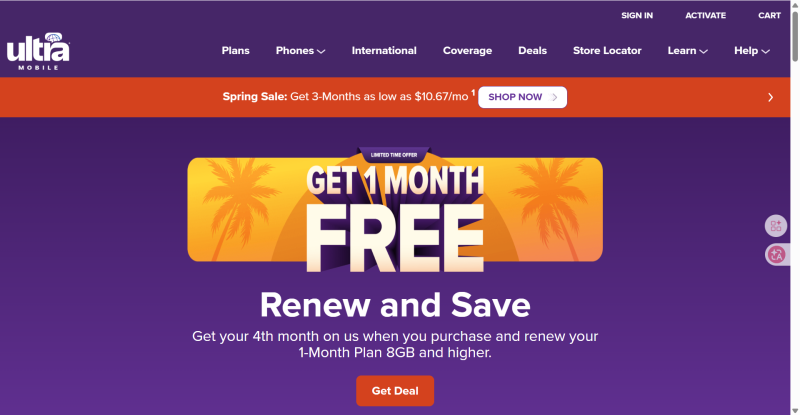
Physical SIM cards offer the highest stability. They are real mobile lines and have the highest verification success rate on high‑risk platforms like ChatGPT and Claude. Ultra Mobile PayGo is a popular choice among international users. It uses T‑Mobile’s network, starts at $19/month, supports Wi‑Fi Calling, and can receive SMS while roaming.
Pros
Cons
Best for: Individuals who need to maintain 1‑2 core high‑value accounts and are willing to pay the upfront acquisition cost.
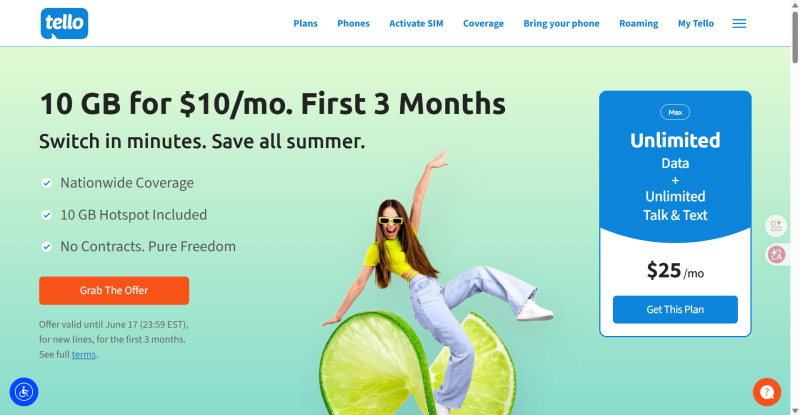
eSIM eliminates the shipping step. You buy online and receive activation credentials immediately. Tello Mobile is a typical example; plans start at around $6/month and let you customize data and talk minutes.
Pros
Cons
Best for: Individual users with compatible overseas‑market phones and some networking experience.
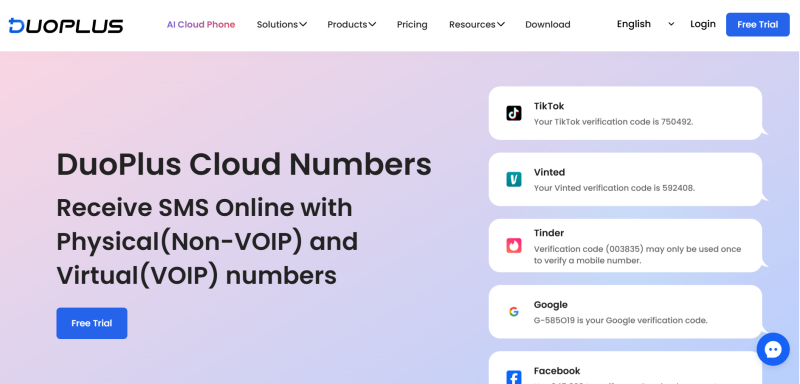
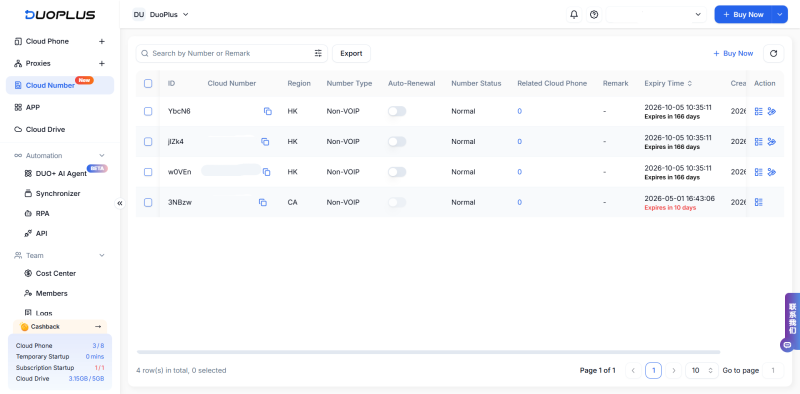
Given the difficulty of obtaining physical SIMs and the complexity of eSIM activation, cloud number solutions like DuoPlus are becoming a new choice. Cloud numbers are based on cloud services – you don’t need any phone hardware. You receive SMS via a web dashboard. DuoPlus Cloud Numbers cover Hong Kong, the US, the UK, Indonesia, and other countries/regions. They offer both virtual VoIP numbers and physical mobile numbers, supporting registration and secondary verification for mainstream platforms such as TikTok, Facebook, Amazon, and SHEIN, as well as AI accounts like ChatGPT and Claude.
Pros
Cons
Best for: Costs as low as $0.13/day. Ideal for long‑term binding of personal core accounts (e.g., ChatGPT, Claude), as well as bulk account creation and operations for cross‑border e‑commerce and marketing teams.
With increasingly strict risk controls globally, choosing the right US number directly affects the stability of account registration, verification, and long‑term use. You should consider number source purity, device compatibility, and your use case.
Number purity is key to avoiding risk control and ensuring high verification success. Traditional Google Voice numbers and VoIP numbers from disposable SMS platforms are virtual, public, and often abused – they are already blacklisted by many platforms, leading to verification failures or account anomalies. In contrast, clean physical SIMs, legitimate eSIMs, and exclusive cloud numbers have no shared history or past violations, offering much higher security. For users who need instant usability, DuoPlus’s clean exclusive cloud numbers require no complex setup and are well‑suited to today’s risk‑control environment.
Device and network compatibility are essential for normal activation. When choosing a physical SIM or an overseas eSIM, confirm that your phone supports US frequency bands – especially since most phones sold in China do not support overseas eSIMs; buying blindly leads to activation failure. Meanwhile, remote eSIM activation requires a stable network environment; network fluctuations or improper settings can interrupt activation and lock the number. Before selecting a solution, verify your hardware and use a stable, compliant network.
For individuals with a few accounts and everyday cross‑border verification needs, physical SIMs and eSIMs offer strong stability, and enabling Wi‑Fi Calling can reduce roaming costs. For teams managing many accounts, bulk registration and verification, or when limited by hardware, cloud numbers are clearly advantageous. They don’t rely on physical devices, support batch provisioning, and offer unified management – delivering greater flexibility and efficiency for scaled cross‑border operations.
| Solution Type | Example | Stability | Acquisition Barrier | Secondary Verification (2FA) | Best For |
|---|---|---|---|---|---|
| Physical SIM | Ultra Mobile PayGo | High | High (requires overseas shipping or forwarding) | ✅ Yes | Long‑term maintenance of a few high‑value accounts |
| eSIM | Tello Mobile | Medium | Medium (requires compatible device and proper network) | ✅ Yes | Individual users with compatible devices and some networking experience |
| Cloud Numbers | DuoPlus Cloud Numbers | High | Low (online, ready instantly, no hardware needed) | ✅ Yes (unlimited during rental) | Long‑term personal account maintenance, team batch operations |
Public disposable SMS platforms use shared numbers with complicated histories and cannot be used for future login verifications. DuoPlus cloud numbers are exclusive to you during the rental period – more private and secure, and support unlimited re‑verification, suitable for long‑term binding of core assets.
Physical SIMs and eSIMs typically have a grace period of 30‑60 days after missed payment before being permanently deactivated. Cloud numbers will send multiple reminders before expiry, and there is a short protection period after expiration. However, to keep important accounts safe, it is recommended to enable auto‑renewal.
This usually happens because your network IP address or browser time zone does not match the number’s home region, triggering the platform’s anti‑fraud system. When registering, make sure your proxy node is in the number’s country, clear your browser cache, or use incognito mode and try again.
Traditional physical SIMs are limited by the phone’s SIM slot, and eSIMs by the phone’s chip – managing many numbers alone is difficult. Cloud numbers, on the other hand, are cloud‑based. You can rent and manage dozens of numbers from different countries in a single web dashboard – ideal for multi‑account operations or team collaboration.
Physical SIMs like Ultra Mobile, after enabling Wi‑Fi Calling, can make calls and send/receive SMS just like a normal phone. Cloud numbers like DuoPlus are dedicated to SMS reception – they do not support making or receiving calls, nor sending SMS.
In summary, choosing a US number comes down to balancing security, compatibility, and practicality. Under ever‑tighter risk controls, whether you are an individual user or a team managing operations at scale, you should focus on number source purity, device and network matching, and realistic use cases. This approach will help you avoid risk controls and failures, ensuring your overseas accounts and business run smoothly and compliantly in the long run.
As TikTok, Instagram, and Facebook become important channels for brand marketing, content creation, and affiliate …

TikTok Shop gives sellers multiple ways to reach potential customers, from shoppable videos and livestreams to creator …
When managing multiple social media accounts, you often need to handle large amounts of text, including post captions, …
No need to purchase multiple real phones.
With DuoPlus, one person can operate numerous cloud phones and social media accounts from a single computer, driving traffic and boosting sales for you.