


How to Manage Multiple Social Media Accounts with DuoPlus Cloud Phone: A Guide to Device Names, Tags, and Groups
As TikTok, Instagram, and Facebook become important channels for brand marketing, content creation, and affiliate …
Learn how to stabilize traffic and conversions for TikTok Affiliate multi-account operations. Discover the risks of duplicate content, how to differentiate video angles across accounts, and best practices for standardized publishing workflows.

Get an AI-Powered Summary of This Article
Many TikTok Affiliate teams run multiple accounts and produce a large number of videos, but traffic and conversions still remain unstable. In many cases, the real problem is not the content itself. The issue is that videos posted across multiple accounts look too similar: the same script, the same voiceover, and the same shot structure, with only the cover, title, or product link changed.
From TikTok’s perspective, this kind of content is more likely to be identified as low-quality, non-interactive, or lacking meaningful originality. TikTok Shop ’s 2026 creator enforcement materials explicitly list unoriginal and unengaging content as problem categories that may trigger enforcement. In more serious or repeated cases, TikTok Shop may take actions such as content removal, product feature restrictions, commission freezes, reduced reach, or even removal of e-commerce permissions.
For teams that manage multiple TikTok Affiliate accounts, the real goal is not simply to publish more. It is to make each account’s content look like a legitimate test, not a batch copy.
Many people think of “duplicate content” only as a copyright issue. But in TikTok Affiliate operations, the impact usually appears earlier in distribution and product-link functionality.
First, click-through rate and views may decline. TikTok Shop’s content rules make it clear that low-quality content can limit performance, while content that people actually want to watch, like, and comment on has a better chance of earning stronger engagement and more reach. By contrast, videos that follow the same structure, show little variation, and feel non-interactive are more likely to be treated as low-quality or non-interactive content.
Second, product-link functionality may be restricted. TikTok Shop ’s 2026 content posting limit update says that if you publish 5 or more non-interactive or misleading TikTok Shop videos within the past 7 days, a posting limit will be applied. Once that happens, any additional TikTok Shop videos can still be published, but their product links will be hidden. That directly affects the core conversion function of TikTok Affiliate videos.
Third, commissions and e-commerce permissions may be affected. Violations can lead to content removal, feature restrictions, commission-related consequences, lower reach, and in repeated or serious cases, loss of e-commerce privileges.
Fourth, copyright and content ownership risk may increase. TikTok’s copyright policy says users are not allowed to post another person’s copyrighted content without permission unless there is a legally valid reason, and rights holders can submit copyright infringement reports through TikTok’s online or in-app reporting flows. That means if a team directly reuses other people’s assets across multiple accounts, or fails to manage its own original files clearly, the cost of later disputes can rise quickly.
For operators, the key issue is not whether the platform might misjudge content once in a while. The real issue is that once content starts to look like batch duplication, distribution, product-link visibility, and commissions can all be affected in practical ways.
Managing multiple TikTok Affiliate accounts is a common way to reduce uncertainty, spread platform risk, reach different audience groups, test products faster, and scale commission-based sales. But the problem is usually not multi-account management itself but how the testing is done.
A common mistake is posting the same video to multiple accounts with only a different cover or title. That makes the content look templated and low in variation. A team can absolutely test multiple versions of the same product, but each version needs a clear point of difference.
The same product should not be introduced from exactly the same angle on every account. TikTok Shop’s content guidance encourages creators to use creative storytelling, problem-solving logic, and clear calls to action, which already suggests that videos should not rely on one repeated template. A more practical approach is to separate video angles across accounts, for example:
Start by amplifying a familiar user pain point, such as “not sure how to choose,” “tried it and it didn’t work,” or “it looks too expensive.” This format is more suitable for users who already have a clear need but have not decided yet.
Open with the result, the before-and-after difference, or the key selling point. Let users see the outcome first, then decide whether to keep watching. This usually works better for shorter, faster-paced videos.
Instead of starting with product specs, show the situation where the product is used. This tends to work well for lifestyle, home, fashion, and tool-related products because it helps users picture themselves using it.
Put the price into a comparison frame, such as how much cheaper it is than similar products or what cost it helps save over time. This is often more effective for price-sensitive users who hesitate before buying.
Help users self-qualify by saying things like “great for beginners,” “not ideal for heavy users,” or “better for students, commuters, or small spaces.” This gives the content more judgment and often improves retention after the click.
This does more than reduce the sense of repetition across multiple TikTok accounts. More importantly, it gives each version a different testing purpose, which makes later review easier: you can tell whether the issue came from the angle, the delivery, or the product itself.
If the only thing different across multiple accounts is the title, while the first three seconds, voiceover logic, and pacing all stay the same, both the platform and the viewer will still see highly similar content.
A more effective test is to change things like:
the first line of the opening
whether a person appears on screen
whether the product is shown first
whether the voiceover is statement-based or Q&A-based
whether the video is compressed and fast-paced or slower and more explanatory
These changes feel more real than simply swapping the cover, and they make it easier to identify what kind of delivery works best for each TikTok account.
TikTok Shop creators can be grouped into different creator types, including Affiliate, Marketing, and Official Shop creators. For multi-account operations, it is more useful to think in terms of account roles than account quantity alone.
For example, a team can assign roles like:
Focused on quickly validating hooks, scripts, and product angles. The goal is testing efficiency, not perfect completeness for every video.
Better suited to showing the product through real use, helping viewers imagine the product in context.
Better for explaining key selling points, ideal users, FAQs, and buying reasons, which supports more rational purchase decisions.
Better suited to centralized conversion, taking short-video traffic and moving it toward live selling or product showcase activity.
Once each TikTok account has a clearer role, the content tends to become naturally more differentiated, which reduces the risk of multiple accounts looking too similar.
TikTok Shop allows creators to generate separate links for different products, product collections, or campaigns, and to view data such as clicks, views, GMV, and sales performance. That means different accounts can absolutely use different product mixes, different links, and different CTAs, instead of pushing the exact same entry point on every account.
For teams, this has two advantages:

Content differentiation is the foundation. But a standardized publishing workflow is what makes multi-account operations stable over time.
For many teams, the problem is not a lack of ideas. The problem is that publishing gets messy:
A more stable approach is to standardize the publishing process in 4 steps.
For every TikTok video version that is about to be published, the team should at least keep a simple sheet with:
This helps the team understand the purpose of each video instead of publishing content in an unstructured way.
For a TikTok Affiliate video, it is better not to keep only the final in-platform export. A more stable setup is to keep:
This makes future re-editing and optimization easier, and it also helps when content ownership questions or internal version confusion come up later. TikTok’s copyright rules make this especially important when multiple people or accounts are involved.
Many TikTok teams carefully separate scripts and covers but ignore publishing time. In practice, if several accounts publish highly similar videos within a short period, the content is more likely to look like batch duplication. On the other hand, spacing out publishing times and giving different accounts different rhythms is itself part of reducing the sense of repetition.
As the number of TikTok Affiliate accounts grows, teams need to pay as much attention to publishing execution as they do to creative variation.
For example, different script versions of the same product need to be assigned to different TikTok accounts. Different accounts may also need different product links, publishing times, and content rhythms. If all of this still depends on manual account switching, repeated uploads, and temporary note-taking, teams are far more likely to mix up versions, publish too close together, or attach the wrong links.
From TikTok’s perspective, that kind of operational mess may not automatically count as a violation, but it can make multiple accounts look more like batch distribution.
So for teams that want to manage multiple TikTok Affiliate accounts consistently over time, it is not enough to differentiate the content. The publishing layer also needs to be separated and managed clearly. Account environments, asset versions, link setup, and publishing times should all map to specific account roles, instead of being mixed into the same device setup and the same operating flow.
This is where DuoPlus Cloud Phone can help. Its isolated cloud-based Android environments are well suited for separating the operating environments of different accounts and reducing the management pressure that comes from running multiple accounts on shared devices. For teams that repeatedly publish TikTok content and manage multiple accounts, DuoPlus also provides centralized device management and batch operations , which can reduce operating cost and improve efficiency.
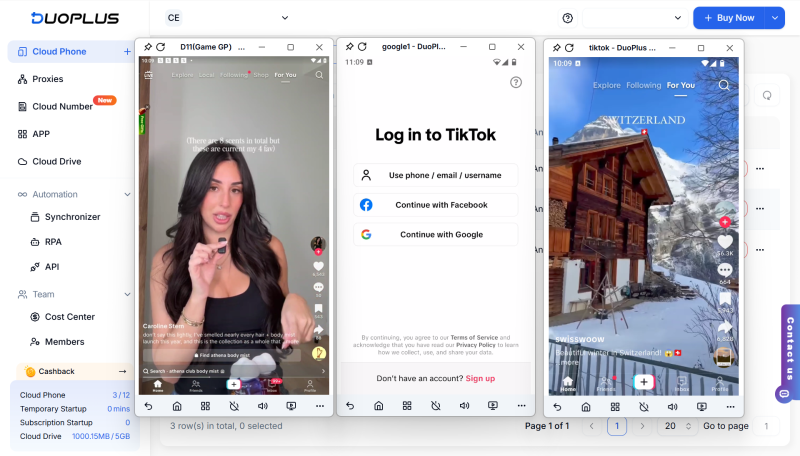
For TikTok teams that manage multiple accounts, content variation determines whether testing is meaningful. The publishing workflow determines whether those tests can run stably and efficiently.
The goal of TikTok Affiliate multi-account management is not simply to open more accounts. It is to make sure each account has a clear role and a clear content purpose.
First, understand the practical risks that duplicate-looking TikTok content can create. Then widen the testing variables across accounts. Finally, standardize the publishing process.
When both the content layer and the publishing layer are properly structured, TikTok Affiliate multi-account management becomes much more stable over the long term.
As TikTok, Instagram, and Facebook become important channels for brand marketing, content creation, and affiliate …

TikTok Shop gives sellers multiple ways to reach potential customers, from shoppable videos and livestreams to creator …

When managing multiple social media accounts, you often need to handle large amounts of text, including post captions, …
No need to purchase multiple real phones.
With DuoPlus, one person can operate numerous cloud phones and social media accounts from a single computer, driving traffic and boosting sales for you.