




How to Sign Up for Meta Muse and Use a Referral Code
Muse has recently become one of the most talked-about AI Agent products in the AI tools space. As a new AI Agent from …
Learn the differences between static and dynamic proxy IPs, how they work, and which proxy type to choose for different business needs. This guide also explains how to configure proxy IPs in DuoPlus Cloud Phone.

Get an AI-Powered Summary of This Article
Proxy IPs are not limited to a single type. Based on whether the IP remains unchanged over time, common proxies can be divided into static proxy IPs and dynamic proxy IPs. Both can hide a user's real IP, but they differ significantly in IP stability, usage methods, and applicable scenarios.
For businesses that need to maintain a fixed network environment over a long period, frequently changing IPs may increase management costs. On the other hand, for tasks that require regular IP changes, using the same IP for an extended period may not meet business needs. Therefore, the key to choosing between a static and dynamic proxy IP is whether the business requires a stable, fixed network exit.
This article explains the characteristics of static and dynamic proxy IPs, compares their differences, and helps you choose the right proxy type based on your actual needs.
A static proxy IP refers to a proxy method that maintains the same proxy IP for an extended period. After configuring the proxy, network requests continue to access the target website through the designated IP unless the user manually changes it or the proxy service itself changes.
For example, if a US IP is configured for a business and remains the same when accessing the internet over an extended period, this is considered a static proxy IP.
However, a static proxy IP does not mean the IP will remain valid permanently. It may still change due to service expiration, IP failure, or adjustments made by the proxy provider. Before using one, check how long the provider guarantees IP stability and what its replacement rules are.
A dynamic proxy IP refers to a proxy method that allows the proxy IP to change during use. The IP can change according to rules defined by the proxy provider, such as time intervals, request counts, or reconnecting to the proxy.
For example, the current request may use IP A. After a predefined rotation condition is met, the proxy switches to IP B, and subsequent requests use the new IP.
Therefore, when choosing a dynamic proxy IP, it is important to understand exactly how the IP changes and whether the new IP will continue to meet your business requirements.
The most direct difference between static and dynamic proxy IPs is whether the proxy IP remains stable during use. Static proxy IPs typically remain unchanged for an extended period, while dynamic proxy IPs change according to time, request count, or other rules.
After a static proxy IP is configured, the same IP is typically used for an extended period without frequent changes. As long as the proxy service works normally, subsequent requests generally continue to use the same IP, resulting in a more stable network environment.
Dynamic proxy IPs, on the other hand, change according to rules defined by the proxy provider. Different services may use different rotation methods, such as changing the IP at fixed intervals, after a certain number of requests, or obtaining a new IP after reconnecting.
The difference can therefore be summarized as follows: static proxy IPs prioritize IP stability, while dynamic proxy IPs prioritize flexibility.
Static proxy IPs are more suitable for businesses that need to maintain a fixed IP and a consistent network environment over time. These businesses typically do not want frequent IP changes because changing the IP may trigger additional verification, interrupt connections, or require access settings to be adjusted.
Dynamic proxy IPs are more suitable for tasks that require frequent IP changes, multiple IPs, or access from different regions. These tasks generally place more emphasis on IP availability and rotation capabilities rather than maintaining the same IP over time.
| Proxy Type | Use Case | Why Is It Suitable? |
|---|---|---|
| Static Proxy IP | API IP allowlists | A fixed IP avoids frequently updating allowlist configurations |
| Long-term social media account management | Maintains a stable network environment and reduces additional login verification caused by IP changes | |
| Fixed corporate network exits | Makes centralized access control and permission management easier | |
| Backend monitoring and data synchronization | Maintains stable connections over long periods and reduces the risk of interruptions | |
| Dynamic Proxy IP | Large-scale public data collection | IPs can be rotated according to predefined rules for accessing large numbers of public webpages |
| E-commerce price monitoring | Different IPs can be used according to task requirements | |
| Multi-region website testing | Makes it easier to switch between IPs from different countries or regions | |
| Localized advertising testing | Uses IPs from target markets to check ad and landing-page displays | |
| Short-term tasks requiring multiple IPs | Provides flexible access to proxy resources without requiring long-term fixed IPs |
Static proxy IPs are typically charged based on the number of IPs and usage duration. After purchasing them, users can maintain fixed IPs for an extended period, making them relatively simple to manage.
Dynamic proxy IPs are more commonly billed based on traffic or request volume. Pricing can also vary depending on factors such as proxy pool size, geographic coverage, and rotation methods. Users also need to pay attention to IP rotation rules and the number of available IPs.
You can determine which type of proxy to use by following the steps below.
This is the most straightforward criterion.
If the business requires the same IP to remain unchanged for an extended period, such as when an IP needs to be added to an allowlist or a stable network environment must be maintained, a static proxy IP should be considered first.
If IP changes do not affect the business, or the business itself requires regular IP changes, you can consider dynamic proxy IPs.
Even if the business does not explicitly require a fixed IP, you should determine whether changing the IP could cause additional issues.
If changing the IP may trigger additional verification, require a connection to be re-established, or affect an existing session, a static IP is generally more suitable.
If the task can tolerate IP changes and requests do not need to maintain the same IP over time, the flexibility of a dynamic proxy IP can be more valuable.
If a task only requires a small number of IPs for long-term use, there is usually no need to choose a dynamic proxy simply for the sake of having more IPs. Static proxy IPs are generally easier to manage.
If a task requires a large number of IPs or needs to switch between multiple regions, dynamic proxy IPs can be considered. In this case, pay particular attention to proxy pool size, geographic coverage, and rotation rules.
Finally, compare pricing methods with actual usage.
If the business requires a small number of IPs for long-term stable use, calculate the cost of static proxy IPs based on the number of IPs and usage duration. If the task is short-term or IP requirements vary significantly, compare dynamic proxy pricing based on traffic or request volume.
The decision can therefore be simplified as:
IP must remain fixed → Choose a static proxy IP. IP can change → Determine whether IP changes affect the business. IP changes do not cause issues and multiple IPs are required → Consider a dynamic proxy IP.
After determining the proxy type, you also need to consider the device environment in which the proxy will be used. For mobile applications such as TikTok and Instagram, a proxy IP mainly addresses network access, while account operations also require a stable and independent device environment.
Therefore, when both a clean mobile device environment and proxy management are required, you can use a cloud phone and configure the proxy on the corresponding cloud phone, such as DuoPlus Cloud Phone.
DuoPlus supports custom proxy configurations. Users can enter the proxy IP, port, username, password, and other parameters provided by the proxy service, and assign the proxy to the corresponding cloud phone.
The basic process is as follows:
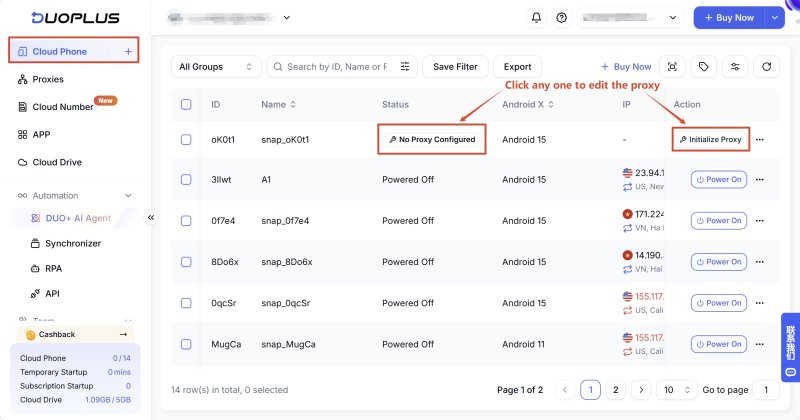
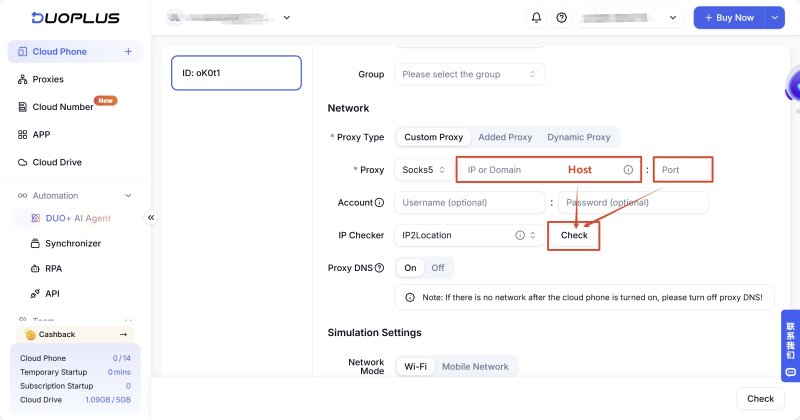
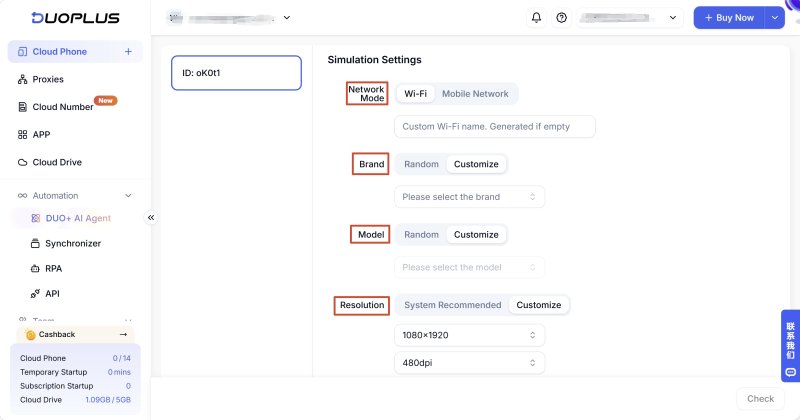
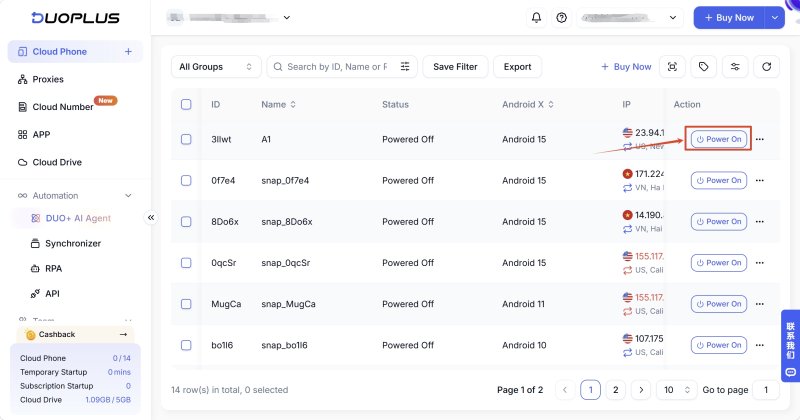
The core difference between static and dynamic proxy IPs is whether the IP remains stable. Static proxy IPs are suitable for businesses that require a fixed IP and stable long-term connections, while dynamic proxy IPs are better suited to tasks that require IP changes, multiple IPs, or access from different regions.
When choosing a proxy IP, first determine whether the business requires a fixed IP, then consider whether IP changes could affect connections or sessions, and finally evaluate the number of IPs, geographic requirements, and overall cost.
However, a proxy IP is only one part of the network environment. For mobile applications such as TikTok and Instagram, platforms may also consider device environments, login behavior, and other factors when evaluating account activity. In actual operations, choosing the right proxy IP should therefore be combined with maintaining an independent and stable device environment.
Neither is universally better. The right choice depends on your business needs. Choose a static proxy IP when you need a fixed IP, and consider a dynamic proxy IP when you need to change IPs.
There is no universal rotation interval. IPs may change every few seconds, minutes, after a certain number of requests, or according to other rules. Check the proxy provider's specific configuration.
It depends on the network environment required by the account. If you need to maintain a relatively stable login environment over time, a static proxy IP may be more suitable. For multi-region testing or short-term tasks, a dynamic proxy IP can be considered based on the specific requirements.
Yes. Different tasks have different IP stability requirements, so static and dynamic proxy IPs can be configured separately according to specific business needs.
Muse has recently become one of the most talked-about AI Agent products in the AI tools space. As a new AI Agent from …

OpenAI Codex is an AI coding agent designed to help developers write, modify, review, and deliver code. It is available …

VK (VKontakte) is one of the major social media platforms in Russia. In addition to account management, content …
No need to purchase multiple real phones.
With DuoPlus, one person can operate numerous cloud phones and social media accounts from a single computer, driving traffic and boosting sales for you.