




How to Use ADB with Cloud Phones: Common Android App Testing Scenarios and Methods
Android app testing often involves repeatedly installing apps, testing different versions, performing fixed operations, …
Learn how to effectively manage multiple Pinterest accounts for brands, regions, and testing. Discover best practices for account structure, localized content, team permissions, and data analysis to boost your visual marketing performance.

Get an AI-Powered Summary of This Article
For sellers, brand teams, affiliate marketers, and content operators, Pinterest is more than an image discovery platform. It can also support product presentation, visual search, content discovery, website traffic, and brand storytelling. According to Pinterest Help Center , a Pinterest business account gives users access to Pin analytics and ads; Pinterest Business also notes that every Pin can link directly to a website and may include images, videos, or a mix of both to showcase products, ideas, or brand stories.
When a team manages only one product line or one market, a single Pinterest account may be enough. However, once a team starts managing multiple brands, different regional markets, different languages, or multiple creative tests, a single account can quickly become difficult to manage. Content may become mixed, performance data may become harder to interpret, assets may be difficult to organize, and daily work may become less efficient.
At this stage, managing multiple Pinterest accounts should not simply mean creating more accounts. The priority is to define the role of each account clearly. A brand account can focus on long-term brand presentation, a regional account can support localized content and links, and a test account can be used to validate creative assets, topics, and posting strategies.
Pinterest organizes content differently from many other social platforms. Boards are used to save, collect, and organize Pins, helping users browse ideas and explore content. For business accounts, Boards can also support content structure, product presentation, and a clearer browsing path for users.
Because Boards influence how users understand an account’s content structure and positioning, placing multiple brand lines, regional content, test materials, and historical Pins in one account may reduce management effort in the short term but create operational issues over time.
Common issues include:
The better approach is not to create Pinterest accounts in bulk without a structure. Instead, teams should build a clear account system. In a multi-account Pinterest setup, brand accounts, regional accounts, and test accounts should each carry a different operational purpose.
A Pinterest brand account is best suited for long-term brand presentation and core content storage. It should not change positioning frequently, nor should it be used to publish large amounts of unverified test content. A brand account should maintain a consistent visual style, clear Board categories, and stable link destinations.
A Pinterest brand account can focus on three types of content.
A brand account should prioritize Pins that represent the brand’s core categories, main selling points, and long-term product direction.
For example, a fashion brand can build Pinterest Boards around seasonal outfits, collection themes, styling ideas, and product categories. A home brand can organize Boards by room type, interior style, product use case, or lifestyle scenario.
Pinterest users often form their first impression of a brand through visual content. The account cover, Pin design, title style, and Board naming should remain visually consistent.
A brand account should avoid switching too frequently between unrelated content styles, such as tutorials, discount graphics, and unrelated lifestyle images. When the visual tone changes too often, the account may become harder to recognize and less useful for long-term brand building.
On Pinterest, each Pin can link directly to a website. For a brand account, links are better directed to official websites, core product pages, brand campaign pages, or long-term content pages rather than temporary test links.
The main goal of a Pinterest brand account is not short-term testing. It should help users understand who the brand is, what type of content it provides, and which products or pages are worth exploring further.
When a brand operates across multiple markets, a single Pinterest account may not be able to serve different languages, seasonal moments, product links, and user preferences at the same time. User behavior, local holidays, product expectations, and landing page structures can vary significantly by market.
A regional account can help teams create a more localized Pinterest experience.
Pinterest users in different language markets may search in different ways. English, Spanish, French, and other language markets should not simply use direct translations of the same Pin titles and descriptions.
Instead, Pin titles, descriptions, and Board names should reflect how users in that market actually search and browse. This helps the account better match local search behavior and improve content discovery.
Regional accounts can be planned around local holidays, seasonal changes, and shopping moments.
For example, a North American account may focus more on Halloween, Thanksgiving, Christmas, and seasonal gift planning. Other markets may have different holidays, climate patterns, or sales cycles. Content calendars should reflect these differences rather than using one global schedule for every market.
If different markets use different websites, pricing, inventory, product pages, or customer support channels, the Pin links should also be separated by region.
Sending users to a landing page that does not match their language, location, or product availability may reduce user trust and lower conversion potential. Regional accounts should therefore connect content, language, and landing pages in a consistent way.
A Pinterest regional account should not simply repost brand account content. Its purpose is to adapt content to local language, seasonal context, user preferences, and website destinations, so the team can better understand how different markets perform.
A Pinterest test account can help reduce the testing burden on brand and regional accounts. It is better suited for testing image styles, Pin titles, Board categories, link directions, and posting times. It should not be used as the main brand presentation account.
A test account can focus on the following areas.
The same product can be tested with different backgrounds, layouts, text overlays, colors, and scenes.
For example, one product can be tested through a clean product image, a lifestyle scene, a tutorial-style graphic, and a comparison image. The team can then observe which format generates more saves, clicks, or outbound traffic.
Pinterest content depends not only on visuals but also on titles and descriptions. A test account can compare different keyword angles for the same topic, such as tutorial-based titles, list-style titles, scenario-based titles, and purchase-decision titles.
A test account can first validate whether certain Board categories have enough performance before moving similar structures to brand or regional accounts.
Pinterest business accounts can schedule standard Pins up to 30 days in advance. Pinterest Help Center also notes that only one Pin can be scheduled at a time, with up to 10 Pins scheduled for the future. For a test account, a smaller posting schedule can be used to compare different posting times before applying the rhythm to official accounts.
The value of a test account lies in validation. Each test should define the topic, creative version, link destination, and observation metrics before publishing.
Pinterest Business Manager supports team and partner collaboration. According to Pinterest Help Center, Business Manager can be used to manage partner and employee access, user permissions, ad accounts, and profile access. Pinterest also allows parent and child account structures for more complex organizations.
For teams managing multiple Pinterest accounts, permissions should be organized around three principles.
Brand accounts, regional accounts, and test accounts should not give every team member the same level of access.
The person responsible for brand content should mainly manage the brand account. The person responsible for localization should manage the relevant regional account. The person responsible for testing should only need access to the test account and related asset records.
Content team members, ad managers, operators, and external partners should have different permission levels. External partners should not directly use the team’s core login credentials. A clearer permission structure is better for collaboration and accountability.
When multiple people work on Pinterest accounts, teams should maintain a shared asset sheet, link sheet, and publishing schedule.
Each record should include:
This makes later review, reporting, and troubleshooting easier.
Pinterest business accounts can review Pin stats and analytics. Pinterest Help Center explains that Pin stats show real-time metrics for created Pins, while Pinterest Analytics helps businesses understand overall Pinterest performance across paid and organic content.
The main difference between single-account and multi-account Pinterest management is not simply collecting data from each account. The key is to analyze data according to each account’s role.
For example:
Once the roles of the three account types are clear, teams can evaluate content, audience, and landing pages more accurately. Separating variables across accounts makes analysis more useful. It helps the team identify whether a performance issue comes from the creative asset, the market fit, or the landing page.
Pinterest teams should avoid reviewing only one account in isolation. A more useful approach is to compare brand account baseline performance, regional account localization results, and test account experiment data together. This provides a clearer basis for improving the overall Pinterest content strategy and traffic performance.
When Pinterest multi-account management becomes a long-term workflow, account roles and data analysis are only part of the challenge. Device usage can also affect daily collaboration. Different accounts may require different assets, regional accounts may need different links, and test accounts may need repeated creative validation. Team members also need a clear way to divide account maintenance work.
DuoPlus Cloud Phone can help teams place different Pinterest accounts in separate cloud-based Android environments, reducing the management pressure caused by frequent local device switching or shared-device use.
In this scenario, DuoPlus Cloud Phone can support Pinterest teams in two main ways:
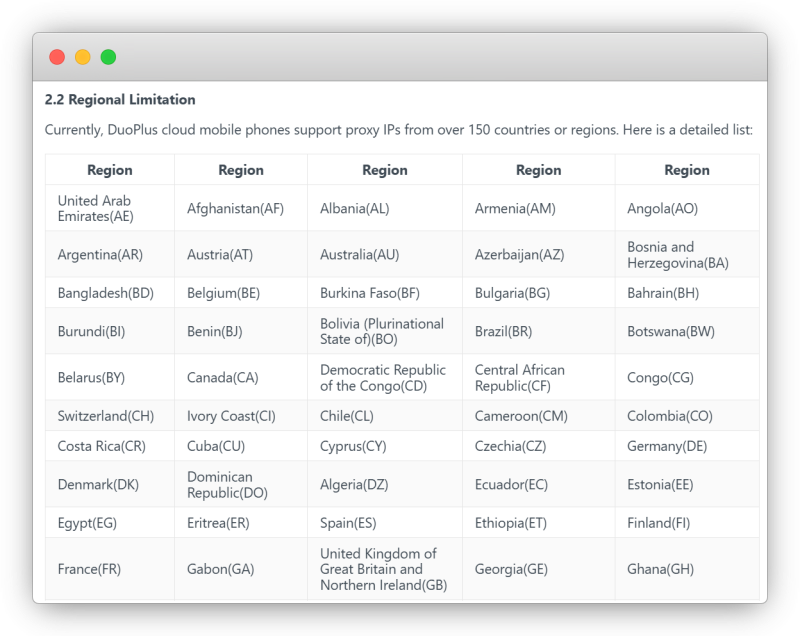
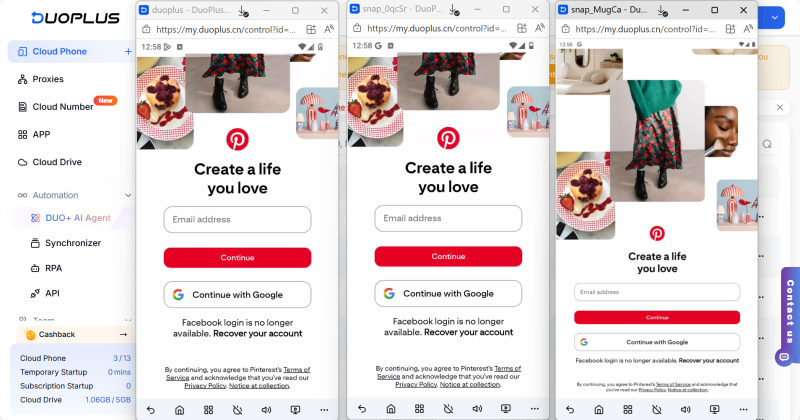
DuoPlus does not change the Pinterest content strategy, nor does it replace Pinterest’s official account management features. It is better suited for helping multi-account teams organize their mobile account environment so that accounts, assets, and team responsibilities remain easier to manage.
Pinterest multi-account management is not about creating more accounts. It is about defining what each account is responsible for. A brand account supports long-term brand presentation and core content storage. A regional account supports localized content and link destinations. A test account validates creative assets, Pin titles, Board categories, and posting times.
For sellers, affiliate marketers, and content teams, the real challenge is account structure, asset organization, link management, and team collaboration. Once these relationships are clearly defined, content publishing, data analysis, and long-term account maintenance become easier to manage.
Android app testing often involves repeatedly installing apps, testing different versions, performing fixed operations, …

Instagram management is about more than likes and follower counts. For individual creators, brand accounts, and …

When creating YouTube videos, the script determines the video’s structure, pacing, and completeness. For creators who …
No need to purchase multiple real phones.
With DuoPlus, one person can operate numerous cloud phones and social media accounts from a single computer, driving traffic and boosting sales for you.