


How to Sign Up for Meta Muse and Use a Referral Code
Muse has recently become one of the most talked-about AI Agent products in the AI tools space. As a new AI Agent from …
Compare Instagram and YouTube for your 2026 social media strategy. Learn which platform offers faster traffic versus long-term conversion, how to distribute content effectively, and how to manage multiple accounts using cloud tools.

Get an AI-Powered Summary of This Article
When teams plan their social media strategy in 2026, Instagram and YouTube often get compared side by side. Both support short-form video, both can grow visibility, and both can contribute to conversion. But when you have the same set of content assets, which platform should you prioritize first: Instagram or YouTube?
Many teams also run into the same problem when they try to operate both at the same time: traffic gets split, conversion becomes harder to track, and it becomes unclear where the main investment should go. In many cases, the issue is not content quality. It is a platform-fit problem.
Instagram continues to push recommendation quality and originality, especially around Reels, while YouTube’s 2026 direction is built around creators as studios, multi-format viewing, and stronger monetization pathways. In YouTube ’s own 2026 roadmap , the company explicitly highlights “every format on every screen,” creator business growth, and YouTube Shopping.
In practical terms, Instagram is usually better for shorter conversion paths and faster traffic actions, while YouTube is better for deeper education, search discovery, and longer-term conversion. The real goal is not to choose the bigger platform. It is to match your business model to the right platform logic.
If your main goal is to generate attention quickly and push users toward immediate next steps, Instagram is usually the stronger front-end growth platform.
It is especially useful for:
Instagram officially supports profile links, and professional accounts have access to tools like Insights. Instagram has also continued to strengthen how original Reels are recommended, while profile links remain a key off-platform conversion point.
That makes Instagram especially effective for short conversion flows such as:
Reel view → profile visit → link click or DM → website, offer page, or owned contact channel
For visual products, impulse-friendly offers, and campaigns that depend on quick attention, Instagram is often the faster route.
If your business depends on education, trust-building, and discoverable content that keeps working over time, YouTube is usually the better core platform.
YouTube is stronger for:
In YouTube’s 2026 roadmap, the platform explicitly states that creators are becoming “the new stars & studios,” and that viewers increasingly use YouTube across long-form video, Shorts, livestreams, podcasts, and TV screens. It also highlights shopping, brand deals, and multiple ways for creators to earn as key priorities.
YouTube Shopping also supports product tagging in videos, Shorts, and live streams, and YouTube says creators can track tagged-product performance in YouTube Analytics.
So if your business needs product education, trust-based conversion, and content that can keep attracting qualified viewers over time, YouTube usually has the stronger long-term payoff.
From a product design perspective, Instagram works as a connected system made up of Reels, Stories, profile pages, and direct messages. For sellers, creators, and affiliate marketers, the real advantage is not one isolated format. It is the short distance between discovery, profile action, and conversion.
Instagram’s recommendation system continues to reward original and eligible content, especially in surfaces like Reels, Explore, and in-feed recommendations. That makes Reels one of the best formats for repeated exposure and quick testing.
Instagram supports adding external links on the profile, which gives users a direct path to a website, campaign page, booking page, or other destination. For brands, lead-gen teams, and affiliate marketers, that profile link setup remains one of the most practical traffic bridges on the platform.
A clear bio, a consistent visual style, and well-structured content on the account page can help users quickly understand what the account offers and whether they should follow, click, or message.
For teams that care about fast traffic, frequent launches, and visually driven conversion, Instagram usually produces results faster because the path from attention to action is shorter.
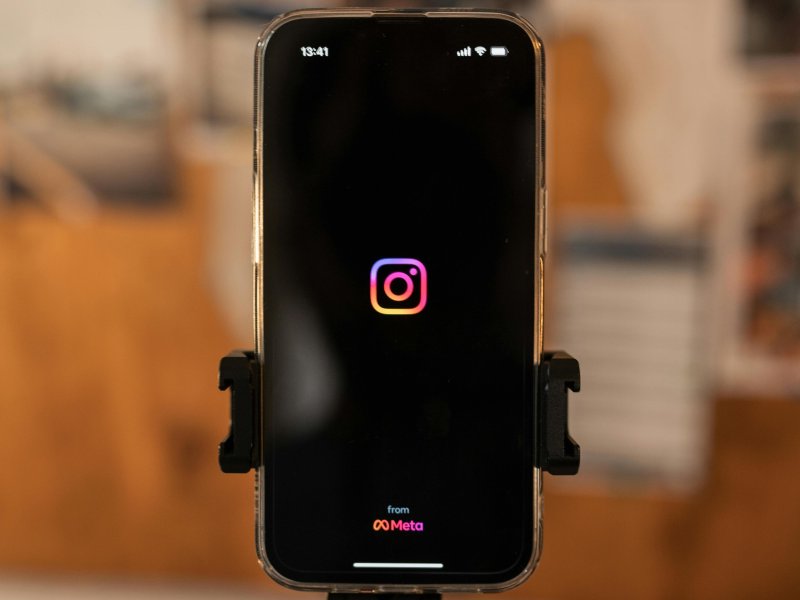
The biggest difference between YouTube and Instagram is that YouTube’s growth model does not rely only on short-term recommendations. It is much better suited to long-term conversion.
YouTube emphasized that the platform is built around “every format on every screen,” meaning Shorts, long-form video, livestreams, podcasts, music, and TV viewing all work inside one ecosystem.
That creates three major advantages.
Tutorials, reviews, buying guides, and problem-solving videos can continue to surface long after publishing through YouTube and Google search behavior. That makes YouTube more useful when your goal is to build content that keeps bringing in qualified viewers over time.
YouTube Shorts are not just for entertainment. They can also introduce product value, answer specific questions, and move viewers toward longer videos or additional product content. YouTube’s 2026 strategy continues to treat Shorts as part of a larger multi-format ecosystem rather than a standalone content lane.
YouTube Shopping supports product tagging across videos, Shorts, and live streams, and viewers can interact with tagged products directly from those surfaces. YouTube also provides Shopping analytics for tagged products. For affiliate marketers, tool-based businesses, and higher-consideration offers, this creates a more complete path from content to product discovery to conversion.
If your offer depends on explanation, comparison, and higher-intent decision-making, YouTube is usually the stronger investment.
A common mistake is posting the same content on both platforms without changing the role of the content. The problem is usually not that teams do not have enough content. The problem is that they are assigning the wrong type of content to the wrong platform.
Instagram is usually a better fit for:
YouTube is usually a better fit for:
The key logic is simple:
In practice, they work better as complementary channels than as replacements for each other.
When teams allocate content across these platforms, they often need to separate brand accounts, regional accounts, test accounts, affiliate accounts, and more, and typically face the following challenges:
These issues do not directly affect the quality of individual pieces of content, but they continuously increase operational overhead. Reliance on manual account switching, frequent device changes, and repetitive uploading can also hinder steady growth.
For multi-account operations, anti-association tools such as DuoPlus Cloud Phone help stabilize the entire account workflow and ensure smooth, secure content publishing across multiple accounts.
DuoPlus Cloud Phone provides an isolated cloud-based Android environment, ideal for running separate accounts independently. Each instance has a unique device fingerprint and IP address to avoid account association detection, reducing the management burden caused by sharing devices across multiple accounts.
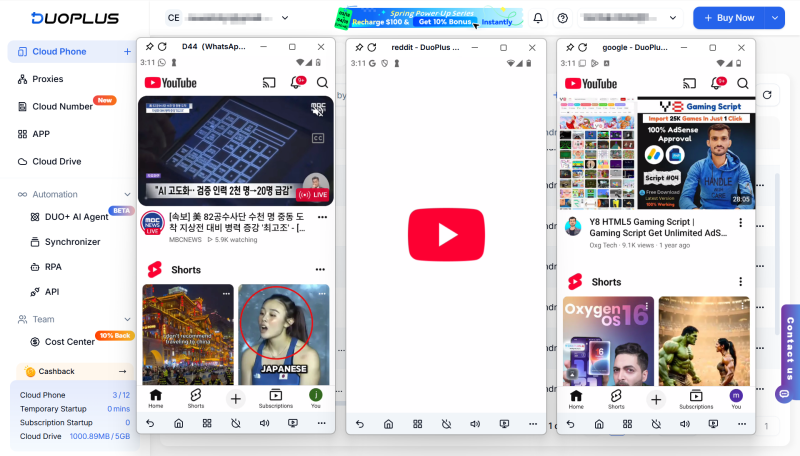
DuoPlus Cloud Phone uses efficient features including AI assistants to complete content distribution across Instagram Reels, Stories, and YouTube Shorts. It supports unified management of multiple accounts and tracks engagement metrics such as likes, comments, shares, and views. This effectively handles repetitive publishing tasks for operations teams and lowers operational costs.
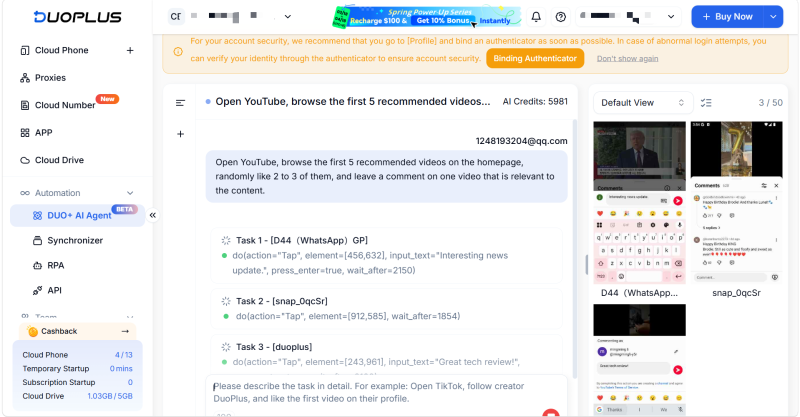
DuoPlus Cloud Phone does not alter platform-specific content logic; it simply makes cross-platform, multi-account content distribution safer and more efficient.
In 2026, the core of building a presence on Instagram and YouTube is not competing for platform traffic volume, but matching each platform to your business’s conversion goals.
When building a social media matrix across multiple platforms, there is no need to blindly create new content. Instead, you can prioritize establishing a stable multi-account publishing workflow using tools like DuoPlus Cloud Phone, enabling more efficient and sustainable social media growth.
Muse has recently become one of the most talked-about AI Agent products in the AI tools space. As a new AI Agent from …

OpenAI Codex is an AI coding agent designed to help developers write, modify, review, and deliver code. It is available …
VK (VKontakte) is one of the major social media platforms in Russia. In addition to account management, content …
No need to purchase multiple real phones.
With DuoPlus, one person can operate numerous cloud phones and social media accounts from a single computer, driving traffic and boosting sales for you.