




How to Log In to Codex: What to Do If You Don't Receive the Phone Verification Code
OpenAI Codex is an AI coding agent designed to help developers write, modify, review, and deliver code. It is available …
Learn the key differences between Facebook Reels and Instagram Reels in 2026. Discover platform-specific strategies for traffic, engagement, and content creation to maximize your brand's reach across the Meta ecosystem.

Get an AI-Powered Summary of This Article
Both Facebook Reels and Instagram Reels are short-form video formats under Meta, but they differ significantly in user scenarios, traffic recommendation algorithms, and content performance. Instagram Reels excels at brand showcasing, visual content, and profile traffic conversion, while Facebook Reels is better for reaching broader general audiences, driving comment engagement, and facilitating community sharing.
However, content does not need to be completely separate between the two platforms. You can repurpose visual content originally created for Instagram on Facebook Reels, and vice versa. The key is to understand the content focus of each platform and adjust accordingly—such as modifying the opening hook, repositioning subtitles, or tweaking the call-to-action (CTA).
In short:
In 2026, Reels has become the core of Meta's content distribution, with three critical shifts in platform rules and traffic logic that have reshaped Reels strategy:
Meta is strengthening recommendations for original content and reducing distribution for non-original and low-value reposted content. A March 2026 Meta policy update explicitly states that original content shot and produced directly by creators will receive higher reach and monetization opportunities, while directly reposted or minimally edited duplicate content may be restricted or even lead to account-wide traffic limitations.
Reels is no longer just a short-form video feature—it has become the primary content distribution entry point across both Instagram and Facebook.
2026 industry data shows that Reels now accounts for 35%–50% of total time spent on Instagram and drives over 40% of platform engagement. Meanwhile, more than half of Reels views come from non-follower recommendations rather than the home feed. Facebook is also doubling down on Reels distribution, integrating it into the home feed, Watch page, and dedicated Reels tab. The platform prioritizes expanding recommendations based on completion rate, share rate, and comment rate.
This means Reels has evolved into a primary organic traffic channel for sellers and content teams, not just another video format. Compared to traditional text and image posts, Meta favors videos with higher completion rates, content that sparks comments and shares, and short-form videos optimized for non-follower audiences.
In 2026, successful Instagram and Facebook content strategy requires building a complete Reels workflow covering ideation and scripting, the first 3-second hook, subtitles and thumbnails, comment engagement, and data analysis.
Accounts with inconsistent styles and unfocused themes may achieve occasional viral hits but struggle to build long-term follower loyalty and content value. Instagram, in particular, increasingly prioritizes overall account positioning and content consistency, with high-quality vertical accounts receiving more stable targeted traffic recommendations.
Against this backdrop, teams managing multiple accounts across Facebook and Instagram can differentiate account roles—creating tutorial accounts, review accounts, lifestyle inspiration accounts, and localized test accounts—to cover all traffic scenarios through a layered strategy across both platforms.
To plan this differentiated multi-platform operation effectively, you first need to understand the core differences between Facebook Reels and Instagram Reels. Their distinct user demographics, viewing scenarios, and content preferences directly determine your creative direction and operational priorities.
The biggest difference is not video aspect ratio or upload interface—it's the underlying user relationships and consumption scenarios:
| Comparison Dimension | Facebook Reels | Instagram Reels |
|---|---|---|
| User Scenarios | Communities, pages, friend connections, local content, video recommendations | Interest-based recommendations, creator content, brand profiles, visual discovery |
| Content Strengths | Mass reach, comment engagement, shareability | Brand showcasing, visual inspiration, profile conversion |
| Ideal Content Types | Life hacks, product demonstrations, comment responses, localized content, practical tutorials | Beauty and fashion, home living, brand stories, tutorials, product showcases |
| Traffic Characteristics | More likely to trigger comments, immediate shares, and broad exposure | Better for targeted interest traffic and long-term account growth |
| Operational Focus | Clear topic, strong practical value, explicit comment guidance | Consistent visuals, clear thumbnails, stable account positioning |
| Common Risks | Low-value reposts, duplicate content, copyrighted material | Inconsistent account style, duplicate content, weak profile conversion |
Meta is continuously driving video consumption growth on both platforms, and both offer significant traffic opportunities—but the nature of that traffic differs:
| Operational Goal | Best Platform | Core Reason |
|---|---|---|
| Build brand image | Instagram Reels | Prioritizes visual presentation, making it easy to create a consistent content style and polished brand profile |
| Acquire targeted interest users | Instagram Reels | Leverages interest-based distribution and clear account positioning to match your ideal audience |
| Expand mass exposure | Facebook Reels | Broader user base and more diverse distribution channels enable rapid large-scale reach |
| Drive comment engagement | Facebook Reels | Integrates with comment sections, communities, and pages, creating a stronger interactive environment |
| Test product selling points | Both Instagram and Facebook | Both platforms support product content testing—simply adjust video openings, subtitles, and CTAs accordingly |
| Build long-term account value | Combined Instagram + Facebook strategy | Complementary strengths: Instagram builds brand image and accumulates targeted users, while Facebook drives mass exposure and content testing |
While both platforms support short-form video, their user scenarios and traffic algorithms require different content focuses:
Instagram users browse Reels to discover new accounts and decide whether to follow them. Your content should therefore align closely with your account positioning, making users think, "I want to see more from this account."
Ideal content types:
Operational tips: Ensure thumbnails, subtitles, the first 3-second hook, profile information, and bio link are all consistent to create a clear brand impression for Instagram users.
Home goods seller examples:
This type of content is perfect for retaining viewers and guiding them to click through to your Instagram profile and bio link.
Facebook users engage with Reels to participate in discussions, leave comments, and share content. Your content should revolve around a specific, discussable topic, making users think, "I have something to say about this" or "I need to share this."
Ideal content types:
Operational tips: State the problem clearly and ground it in specific, relatable scenarios so users can quickly see themselves in the content.
Home goods seller examples:
Many teams repurpose TikTok videos directly to both Reels platforms. While this saves time, posting identical content can lead to poor platform fit and reduced originality scores.
Differentiation strategies:
Once you've planned your content publishing strategy for both platforms, teams managing multiple accounts should assign distinct roles to different accounts—such as tutorial accounts, lifestyle accounts, and review accounts. This allows you to precisely target different user needs while avoiding the limitations of single-account content monotony. A differentiated strategy across Facebook and Instagram will attract your target audience from multiple angles and boost overall brand exposure.

For individual creators, publishing to both platforms simply means uploading a few extra videos. But for sellers, content teams, and those managing multiple accounts, it presents significant challenges:
DuoPlus Cloud Phone is perfectly suited for multi-account Reels operations. It provides isolated cloud-based Android environments, allowing teams to separate different platforms, accounts, and content directions into independent environments with clear content assignments for each account. Teams can:
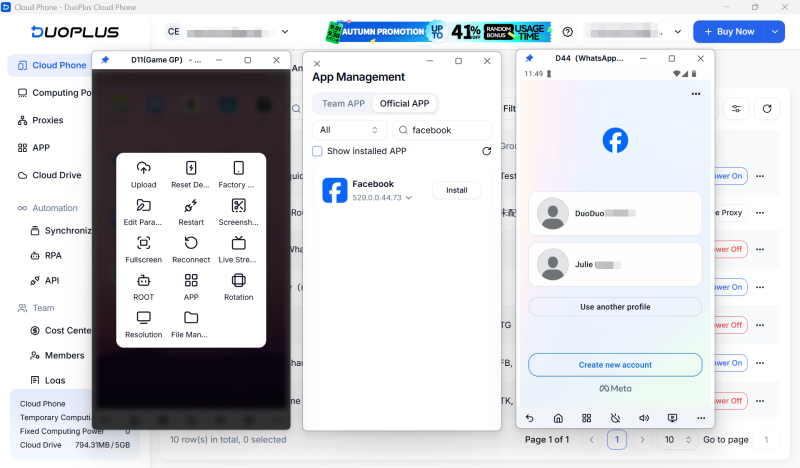
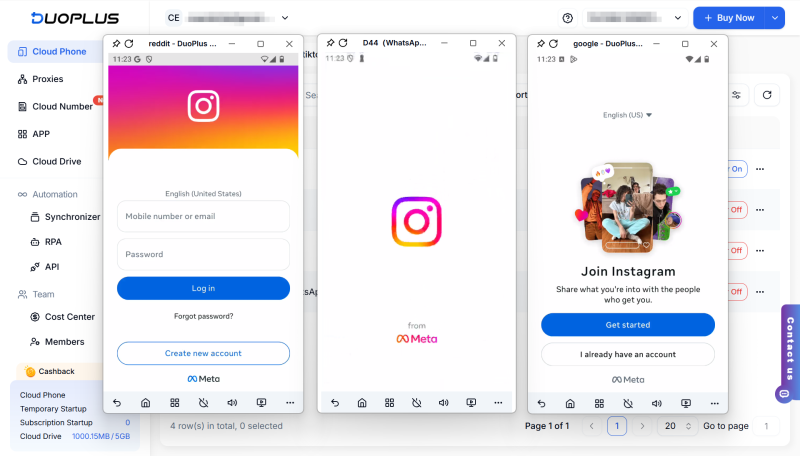
DuoPlus Cloud Phone's value goes beyond just running multiple accounts. It creates clear, stable, and auditable workflows for account division, content management, and publishing across Instagram and Facebook through isolated environments and batch operations.
Yes, but we do not recommend posting identical content. Use the same footage but adjust the title, opening hook, subtitles, and CTA for each platform. The Instagram version should emphasize visuals and profile conversion, while the Facebook version should focus on practical scenarios and comment guidance.
Instagram Reels is better for building targeted followings through consistent account style and vertical content. Facebook Reels excels at achieving broad exposure through mass-appeal topics and engagement. Use Instagram for brand building and long-term audience loyalty, and Facebook for expanding your overall reach.
Yes, but avoid pure hard sells. We recommend the "one problem + one solution" product demonstration format, particularly for cleaning, storage, home goods, kitchen, and tool categories. This helps users quickly understand exactly what problem your product solves.
Yes, especially for visual products and brand-focused accounts. You can guide users to your profile, bio link, or related product content. The key is to have a clear, professional profile and consistent content style.
We recommend separating accounts by platform and content role. Consider using DuoPlus Cloud Phone to host different accounts in isolated environments, making it easier to organize footage, streamline publishing workflows, and track performance data.
Facebook Reels and Instagram Reels are both essential short-form video formats in the Meta ecosystem, but they require distinct operational approaches. In 2026, with Meta's increased focus on original content and Reels' central role in distribution, successful Reels strategy is no longer about syncing the same video across all platforms. Instead, it requires tailoring content to each platform's user scenarios, assigning clear account roles, and conducting data-driven analysis to optimize performance over time.
OpenAI Codex is an AI coding agent designed to help developers write, modify, review, and deliver code. It is available …

VK (VKontakte) is one of the major social media platforms in Russia. In addition to account management, content …

ChatGPT is available through both the web version and desktop/mobile apps. The web version requires no installation and …
No need to purchase multiple real phones.
With DuoPlus, one person can operate numerous cloud phones and social media accounts from a single computer, driving traffic and boosting sales for you.