




How to Increase TikTok Shop GMV: 5 Practical Strategies for Sustainable Growth
TikTok Shop gives sellers multiple ways to reach potential customers, from shoppable videos and livestreams to creator …
Learn how ColaProxy provides reliable proxy infrastructure for developers and businesses. Explore residential, ISP, and mobile proxies for SEO, ecommerce, AI data collection, and automation.

Get an AI-Powered Summary of This Article
Modern businesses depend on reliable access to public web data. Ecommerce teams monitor prices and inventory, SEO teams track regional search results, developers build automation workflows, and AI companies collect multilingual web content for training, retrieval, and market intelligence. In all of these scenarios, stable web access is no longer a minor technical detail. It is part of the data infrastructure behind business decisions.
A single server IP is rarely enough for modern workflows. Websites may display different content based on IP location, session history, request behavior, device environment, and traffic patterns. Some pages change by country or city. Search results vary by region. Ecommerce prices may depend on local markets. Browser automation may require session consistency. When a team depends on web data, network identity directly affects data quality.
This is why proxies are no longer just tools for hiding an IP address. For businesses and developers, proxy infrastructure has become a network identity layer that supports scalable, stable, and location-aware web access.
ColaProxy is a proxy infrastructure provider built for teams that need residential proxies, ISP proxies, mobile proxies, rotating sessions, sticky sessions, and global geo-targeting for modern web data workflows.
ColaProxy is a proxy service provider designed for developers, data teams, ecommerce businesses, SEO professionals, automation users, and AI companies that need reliable access to public web data across different regions.
Instead of offering only a simple proxy endpoint, ColaProxy focuses on flexible proxy infrastructure. Different workflows require different network behavior. Some tasks need rotating IPs for large-scale public data collection. Some require sticky sessions for login flows, browser profiles, or multi-step browsing. Others depend on geo-targeting to access localized prices, search results, or regional market content.
The core value of ColaProxy is helping teams build a controllable web access layer. With residential proxies, ISP proxies, mobile proxies, rotating sessions, sticky sessions, and protocol support, businesses can match proxy strategy to real workflow requirements.
For example, a crawler collecting thousands of public product pages may need rotation and broad IP distribution. A browser automation workflow that checks a logged-in dashboard may need sticky sessions and a stable network identity. A global SEO project may need country-level or city-level access to compare localized search results. These are very different requirements, and they should not be handled with one generic proxy setup.
ColaProxy is suitable for teams that need stable network identity, location control, and scalable web access.
Developers can integrate ColaProxy into Python scripts, Playwright, Selenium, Puppeteer, crawlers, and browser automation systems to manage request origin, location, and session behavior. This is useful when applications need to separate request logic from network routing, especially in multi-worker or browser-based systems.
Ecommerce teams can use ColaProxy for price monitoring, product tracking, inventory checks, competitor analysis, and regional market research. Because ecommerce content often changes by location, reliable geo-targeting can improve data accuracy.
SEO teams can use ColaProxy for SERP monitoring, local rank tracking, keyword visibility analysis, and regional search result comparison. Search results are often personalized by country, city, language, and device environment, so proxy location can directly affect ranking data.
AI and data teams can use ColaProxy for public web data collection, multilingual content discovery, RAG updates, AI search indexing, market intelligence, and real-time data pipelines. For AI workflows, the value is not only access, but also coverage, freshness, and data diversity.
Automation teams can use ColaProxy with browser tools to support session control, location consistency, and stable network routing.
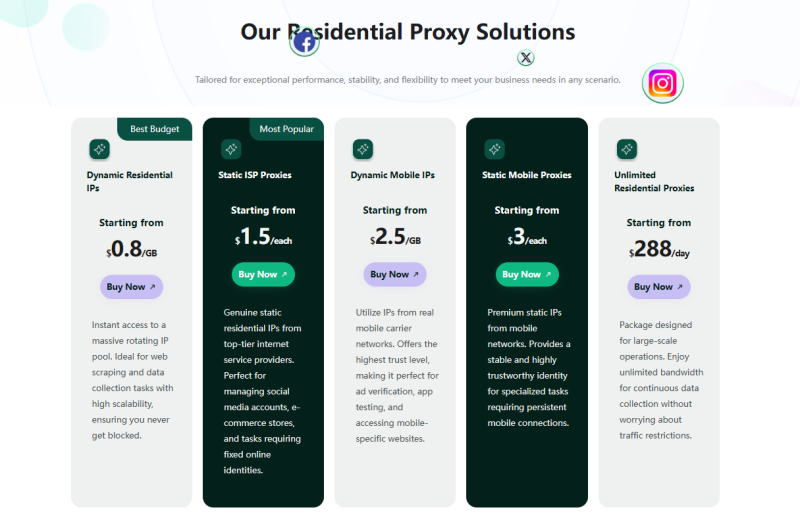
Residential proxies use IP addresses associated with real consumer network environments. They are commonly used for workflows that require stronger trust signals, regional accuracy, and more realistic browsing conditions.
For public web data collection, ecommerce research, SEO monitoring, and market analysis, residential proxies are often a strong choice. They help teams view websites from different countries or regions and collect content that is closer to what local users may see.
For example, the same product page may show different pricing, currency, stock availability, shipping rules, or promotions depending on whether the visitor is located in the United States, Germany, Japan, or the United Kingdom.
Residential proxies are also useful when data accuracy depends on real-world market context. A global brand monitoring competitors, a pricing team checking regional offers, or an AI team collecting multilingual public content may all need residential IPs to see the right version of a page.
ISP proxies are useful when stability and long sessions matter. Compared with constantly rotating IPs, ISP proxies are better for workflows that require a consistent network identity.
They can be useful for account-based workflows, dashboard access, long-running monitoring, session persistence, and multi-step browsing tasks. If a task requires continuity, a stable IP can reduce session inconsistency.
For example, if a browser automation task needs to move through several pages in the same session, a stable IP can help keep the workflow consistent. This is especially important when cookies, account state, or form progress are involved.
Mobile proxies are designed for workflows that require access from mobile network environments. They are useful for mobile-first websites, app-related testing, carrier-based content research, and mobile market analysis.
As more platforms optimize for mobile users, mobile proxies can help teams understand how pages, rankings, content, or offers appear from mobile network contexts.
Mobile proxies are especially relevant for teams studying mobile commerce, app-like web experiences, mobile search behavior, or platforms where carrier networks influence access patterns.
ColaProxy supports broad country and regional coverage, making it useful for global data access. For cross-border ecommerce, international SEO, market research, and multilingual AI data collection, location coverage directly affects data quality.
Geo-targeting is not just about accessing a website from another country. It can determine whether a team sees the right currency, local inventory, shipping options, search results, advertisements, language, or regional landing pages.
For businesses that operate across markets, this matters. A dataset collected from the wrong region can lead to incorrect pricing analysis, inaccurate SEO reports, incomplete product intelligence, or misleading market research.
Rotating sessions are useful for large-scale, stateless public data collection. Each request or group of requests can use a different IP, helping distribute access across the proxy pool.
This approach is suitable for product page collection, search result monitoring, news crawling, directory scanning, and other workflows where each request can be treated independently.
Rotation is most effective when the task does not require session continuity. For example, collecting public category pages or checking search results across many keywords can often benefit from rotation.
Sticky sessions are useful when a workflow needs the same IP for a longer period. Login flows, cart testing, browser profiles, multi-step browsing, and account-based operations often require session continuity.
If a workflow depends on cookies, browser state, or a consistent browsing path, frequent IP changes may create instability. Sticky sessions help maintain a stable network identity during the task.
A good proxy strategy should decide when to rotate and when to stay consistent. Rotating everything by default is not always the best choice.
ColaProxy supports HTTP(S) and SOCKS5, making it easier to integrate into different technical stacks.
Common integrations include Python Requests, httpx, Playwright, Selenium, Puppeteer, browser automation tools, crawling systems, and internal enterprise data platforms.
Protocol flexibility matters because teams often operate mixed environments. One team may use HTTP clients for lightweight crawling, while another uses full browser automation for dynamic pages. Supporting multiple protocols makes the proxy layer easier to standardize.
Businesses can use ColaProxy to collect public web data such as product information, industry directories, news pages, public reports, job listings, and market signals.
Proxy infrastructure helps collection systems access pages from different regions, distribute requests, and improve stability at scale. A mature setup should also include retries, data validation, deduplication, and monitoring, but the proxy layer is often the foundation that determines whether data access remains reliable.
Ecommerce prices often depend on region, stock availability, promotions, and market strategy. ColaProxy can help brands and retailers monitor competitor prices, discount changes, product availability, and regional pricing differences.
This data can support pricing decisions, product strategy, and market response. For example, a retailer may want to compare how a competitor prices the same product across countries, whether discounts are region-specific, or whether inventory changes before a seasonal promotion.
Search results vary by region, language, device, and location. ColaProxy helps SEO teams check keyword rankings, SERP layouts, local search visibility, and search result changes from different markets.
This is especially useful for international SEO and local rank tracking. Without location-aware access, SEO reports may reflect the wrong market and lead to poor decisions.
Teams using Playwright, Selenium, or Puppeteer can use ColaProxy to manage proxy routing, location consistency, and session behavior.
Browser automation workflows often need more than a proxy endpoint. They need stable session logic, matching browser profiles, cookie handling, and consistent access environments. ColaProxy can support these workflows by helping teams align proxy behavior with browser behavior.
AI companies and data teams need public web data for model training, RAG updates, AI search, market analysis, and multilingual content collection.
ColaProxy can act as the network access layer inside AI data pipelines, helping teams build scalable and location-aware data infrastructure. This is especially important when data freshness, regional coverage, and source diversity affect the final AI product.
Basic proxy services often focus only on providing an IP address. Enterprise proxy workflows need more than that. Teams care about IP quality, location coverage, session control, protocol compatibility, reliability, success rate, and operational cost.
| Comparison Area | Basic Proxy Services | ColaProxy |
|---|---|---|
| Proxy Types | Often limited | Residential, ISP, and mobile proxies |
| Geo Coverage | Limited | Broad global coverage |
| Session Control | Basic or limited | Rotating and sticky sessions |
| Use Cases | Simple browsing | Data collection, SEO, ecommerce, AI, automation |
| Protocol Support | May vary | HTTP(S) and SOCKS5 |
| Workflow Fit | Limited | Designed for business data workflows |
For long-running data projects, proxy quality and session design often matter more than the lowest unit price. Low-quality proxies can increase retries, reduce success rates, create incomplete datasets, and raise engineering costs.
A better way to evaluate proxy infrastructure is to look at cost per successful result. If a lower-cost proxy produces more failures, more retries, or less accurate data, the real operating cost may be higher than expected.
Choosing a proxy setup should start with the workflow, not just the price or IP count.
If the task involves large-scale public web collection, residential proxies with rotating sessions are often a good fit. If the workflow requires login state, browser profiles, or multi-step continuity, ISP proxies or sticky sessions may be more suitable. If the task depends on mobile-first environments, mobile proxies may be the right choice.
Teams should also consider target region, request frequency, concurrency, data freshness, retry strategy, and compliance requirements. A mature proxy strategy should be designed together with the crawler, browser automation layer, cookie storage, monitoring system, and data validation process.
Before scaling, it is usually better to test a representative sample. Teams can compare success rate, response time, region accuracy, data completeness, and failure patterns across different proxy types. This gives a clearer view of what setup fits the workflow.
Proxy usage should not only focus on access. Teams should also monitor stability, data accuracy, session consistency, and system visibility.
For public data collection, keep request rates reasonable and avoid sudden traffic spikes. For login-based or multi-step workflows, use sticky sessions to maintain network consistency. For region-sensitive data, match proxy location with the target market. For large systems, monitor success rate, response time, error rate, and data completeness.
It is also important to separate workflows. A pricing monitor, SEO rank tracker, browser automation task, and AI data pipeline may all need different proxy strategies. Combining them into one generic configuration can create unstable results.
A proxy layer should be treated as infrastructure, not as a quick fix added after failures occur. When proxy routing, sessions, retries, and monitoring are designed together, data workflows become more reliable.
ColaProxy is a proxy infrastructure provider for data collection, automation, SEO, ecommerce intelligence, and AI workflows. It supports residential proxies, ISP proxies, mobile proxies, rotating sessions, sticky sessions, HTTP(S), SOCKS5, and global geo-targeting.
For modern businesses, proxies are no longer just tools for masking an IP address. They are part of network identity management, location-aware access, and reliable data collection infrastructure.
If your team needs public web data collection, SEO rank tracking, ecommerce price analysis, market research, browser automation, or AI data workflows, ColaProxy can help build a more stable and scalable access layer for global web data.
TikTok Shop gives sellers multiple ways to reach potential customers, from shoppable videos and livestreams to creator …

When managing multiple social media accounts, you often need to handle large amounts of text, including post captions, …

E-commerce operations and social media content management often require saving product specifications, descriptions, …
No need to purchase multiple real phones.
With DuoPlus, one person can operate numerous cloud phones and social media accounts from a single computer, driving traffic and boosting sales for you.