



How to Log In to Codex: What to Do If You Don't Receive the Phone Verification Code
OpenAI Codex is an AI coding agent designed to help developers write, modify, review, and deliver code. It is available …
Struggling with Codex phone verification? Learn why temporary SMS platforms are risky for developer accounts and why long-term exclusive cloud numbers are the best solution for maintaining stable Codex and OpenAI API access.

Get an AI-Powered Summary of This Article
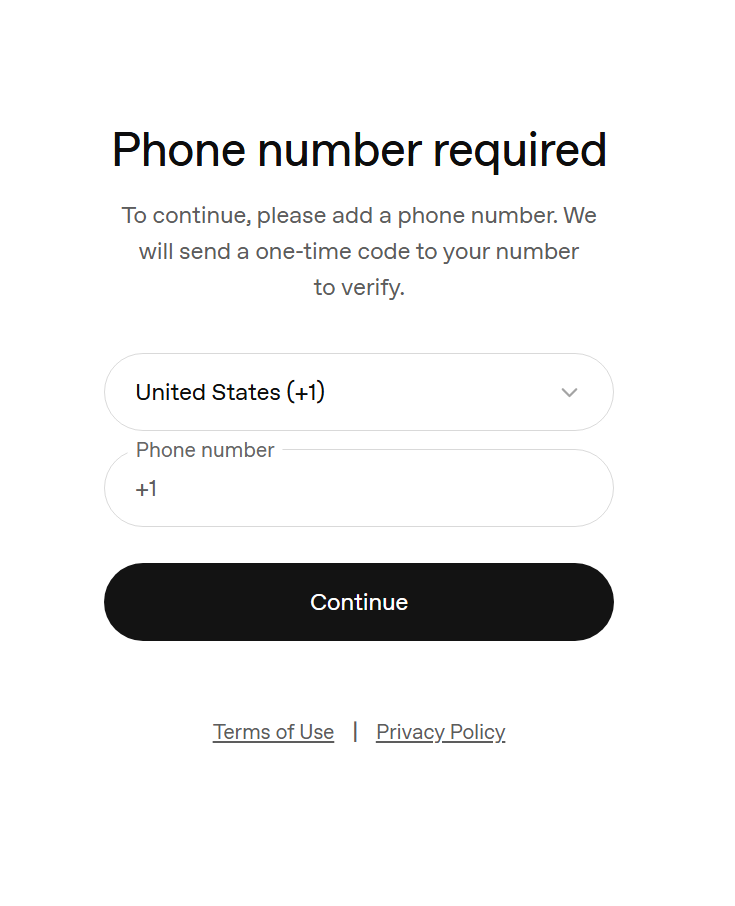
Recently, more developers have started running into phone verification issues with Codex. Some users are asked to add a phone number after logging in on a new device, reopening the Codex app, or completing a browser redirect. Others report that they never receive the verification code at all, which prevents them from continuing to use Codex. This issue is especially frustrating because a Codex account is not just a disposable tool account. It can be tied to code projects, API usage, plugin workflows, and team development environments, which makes account security much more important.
So when dealing with Codex phone verification, the key question is not only whether a number can receive one verification code right now. What matters more is whether that number can receive future codes again, whether it still works when you log in from another device, and whether it is easy for a team to maintain over time. Choosing the right phone-number solution matters.
As a developer-facing tool, Codex connects to code execution tasks, API calls, repositories, and daily development workflows, so its account-security requirements are naturally higher.
At the same time, more abuse cases have appeared in the market. Some users have reportedly used automated registration tools and email-based registration flows to create large numbers of free accounts, which puts pressure on free usage quotas and affects normal users. As a result, OpenAI has started requiring phone verification for accounts that look risky because of login IPs or runtime environments. New free accounts are more likely to trigger this step.
This kind of forced verification is not an isolated case. Users in GitHub and Reddit discussions have also reported being asked to verify their phone number after logging into Codex on different devices. Some said that even after enabling 2FA with an authenticator, Codex still required a phone number, and repeated attempts still failed to deliver the code.
Phone verification is also not limited to the first registration stage. Logging in on a new device, reinstalling or updating the client, or jumping from a browser to the Codex app may all trigger verification again. For teams that use Codex regularly, whether they can complete phone verification smoothly directly affects long-term account stability and security.
When users run into Codex phone verification, the common viable solutions usually fall into three categories: physical phone numbers, temporary SMS platforms, and long-term exclusive cloud numbers. Each option has distinct advantages and limitations, making them suitable for very different use cases.
Note that phone numbers from regions outside OpenAI’s official supported service areas are generally not eligible for verification. Attempting to use such numbers will likely result in failed SMS delivery or account access issues, so you should first confirm your region is supported before proceeding with any of the solutions below.
Physical phone numbers refer to real SIM-based numbers from OpenAI-supported markets such as the US, UK, and Canada. Their primary advantage is that they closely resemble genuine user numbers, making them ideal for long-term binding of high-value accounts.
For Codex and ChatGPT-related accounts, key benefits include:
However, they also have notable drawbacks:
Therefore, physical phone numbers are best suited for a small number of high-value primary accounts, but not ideal for teams managing multiple Codex, OpenAI, or developer accounts simultaneously.
Temporary SMS platforms prioritize speed, low cost, and one-time use. Users can quickly copy a number, receive a single verification code, and complete registration or verification in minutes, which is convenient for short-term needs.
However, they come with significant inherent risks:
These risks are particularly pronounced for Codex accounts, which may trigger re-verification at any time (e.g., after device changes or client updates). If your original number was from a temporary platform, it may no longer be available when re-verification is required. Additionally, OpenAI imposes limits on how many accounts a single phone number can verify during initial API key setup. If a temporary number has already been used by others, you may encounter issues such as:
For these reasons, temporary SMS platforms are only recommended for low-value, short-term testing purposes. They should never be used for Codex primary accounts, API accounts, team collaboration accounts, or long-term paid accounts.
The core value of long-term SMS or exclusive cloud-number platforms lies in their stability and traceability. During the rental period, the same number can receive verification codes repeatedly. High-quality services assign numbers exclusively to a single user, and some offer both virtual and physical number options.
This addresses the key limitations of temporary SMS platforms:
For Codex use cases, this type of number is best suited for primary accounts, team accounts, API accounts, and paid subscription accounts that require stable long-term access.
For Codex accounts, the real issue is not whether a number can receive one code right now. The real issue is whether the number can support the account over time.
| Comparison Area | Temporary SMS Platform | Long-Term Exclusive Cloud Number |
|---|---|---|
| Number ownership | Shared by many users and repeatedly reassigned | Exclusive to one user during the rental period |
| Usage period | One-time or short-term | Can be kept for long-term use |
| Future verification | The original number may no longer be available | Can keep receiving verification codes |
| Best fit | Low-value test accounts | Codex, OpenAI API, and team primary accounts |
| Risk history | The number may already have been used by multiple people | Number history is clearer |
| Team management | Records are fragmented and hard to hand over | Can be centrally managed and grouped |
| Verification scenarios | One-time registration | Registration, login, device changes, and account maintenance |
| Cost logic | Cheap for one use | Better suited to the long-term cost of valuable accounts |
The strength of temporary SMS is low upfront cost and speed, but it solves a short-term task. Long-term exclusive numbers solve the long-term account-maintenance problem. For a tool like Codex, the second issue is clearly more important.
A Codex account may be tied to repositories, project context, API usage, team workflows, and development environments. That means it needs stronger security than many other ChatGPT-related use cases. If a phone-verification step blocks the account, the impact is not just a login problem. It may interrupt development work directly.
The document notes two practical constraints: one phone number can only be used a limited number of times for initial API key phone verification, and OpenAI does not currently let users change the phone number associated with the account themselves. That means the first number choice matters more than it might seem. If a shared temporary number is used at the beginning, replacing or recovering access later becomes much harder.
Codex may ask for phone verification again during normal use, including after device changes, relogins, or app redirects. For teams that use Codex over time, the number should stay available. Otherwise, even if the first verification succeeds, later access may still fail because the code cannot be received again.
If a team binds a Codex account to an employee’s personal number, handover becomes harder when that employee leaves, changes role, or switches devices. With a long-term exclusive cloud number, the team can manage numbers more clearly by recording which platform a number is used for, which email the account is tied to, what the account is used for, and who is responsible for it.
So if the goal is to handle Codex phone verification more safely and manage account security over time, a professional and stable cloud-number solution is a better fit than traditional temporary SMS tools. The document positions DuoPlus’s cloud-number feature in that role.
DuoPlus Cloud Number is positioned as a more stable, manageable, and maintainable way for teams to handle Codex phone verification.
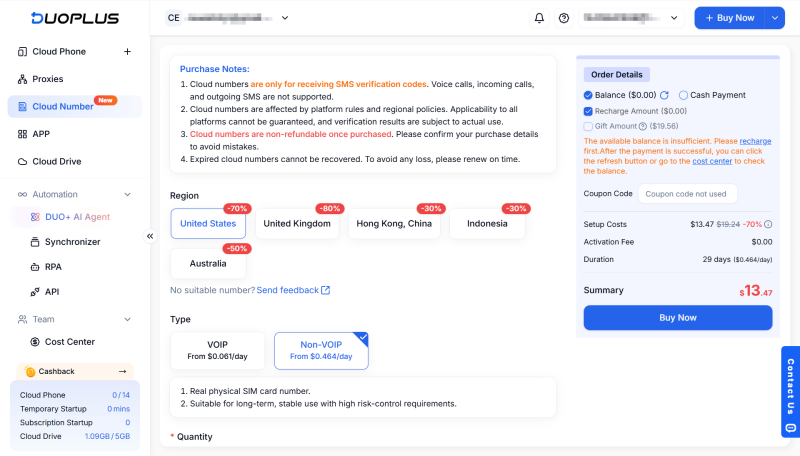
Temporary SMS numbers are often used by many people. DuoPlus Cloud Number, by contrast, is described as assigning a selected number to one user only. That matters for Codex because OpenAI limits how many times one number can be used. A shared number may already have been used before, while an exclusive number is more suitable for long-term account maintenance.
DuoPlus Cloud Number can receive verification codes repeatedly during the rental period, and long-term numbers can be renewed and kept. This makes it more suitable for long-term account maintenance than one-time SMS tools, especially because Codex verification may appear again during login, device changes, or API-related actions.
The document says DuoPlus allows all cloud-number verification codes to be viewed in one backend, without frequent switching between pages or devices. If a team manages multiple Codex, OpenAI, social-media, or store accounts, this can reduce communication cost and make verification records easier to manage.
DuoPlus Cloud Numbers is described as offering both VOIP and Non-VOIP, which makes it easier to match different business needs. For AI tools like Codex or Chatgpt, verification code requests made using virtual numbers are easily blocked. It is recommended to directly purchase a physical number(Non-VOIP) with a real operator to ensure smooth receipt of verification codes and reduce account risk.
The document suggests the following account-planning structure:
| Account Type | Recommended Number | Management Method |
|---|---|---|
| Codex primary account | Long-term exclusive number | Fixed binding, renew long term |
| OpenAI API account | Long-term exclusive number | Record API key creation and verification status |
| Codex test account | Short-term or mid-term number | Keep separate and do not mix with primary accounts |
| Team member accounts | Assign numbers by team member | Easier for permissions and handover |
| Other developer-tool accounts | Group by platform | View verification-code history centrally |
If a team is preparing phone numbers for Codex or OpenAI API accounts, the workflow in the document can be translated into the following steps.
If it is only for temporary testing, a lower-cost option may be enough. If it is a primary account, paid account, API account, or team collaboration account, a long-term exclusive number is the safer option.
If a stable physical number from a supported region is available, that is usually the first option to try.
Temporary SMS is suitable for testing, not for long-term maintenance. Codex may require verification again later, and shared numbers are usually not recoverable.
Do not bind multiple important accounts to the same number. The document recommends managing team accounts more carefully, ideally with one number per account or one number per clearly defined group.
Do not rely only on screenshots of verification codes in chat groups. Create an account sheet and record the platform, email, number, owner, binding time, and verification status.
Expired cloud numbers may not be recoverable and may not be searchable after expiration. If the number is tied to a Codex primary account or API account, renewal reminders should be part of the team account-management workflow.

Codex uses the OpenAI account system, and Codex cloud requires stronger protection because it interacts directly with repositories. Device changes, relogins, API use, or account-security changes may all trigger additional verification.
Not reliably. In the original draft, mainland China was used as the concrete example because it is outside OpenAI’s supported ChatGPT and API service regions. For a global version of this article, the broader rule is that phone numbers tied to unsupported regions are not a dependable verification method.
According to the original document, new OpenAI accounts no longer need phone verification just to create an account or use ChatGPT, but initial API key generation on the platform can still require phone verification.
Temporary SMS numbers are usually shared by many users and may be reassigned repeatedly. Since Codex may require verification again later, a temporary number is not suitable for long-term binding.
According to the document, DuoPlus Cloud Number supports repeat SMS reception during the rental period, long-term renewal, centralized backend viewing of verification codes, and team collaboration and grouping. Ordinary temporary SMS platforms are usually better for one-time verification only.
No. The document explicitly says it cannot guarantee success. Whether verification succeeds still depends on OpenAI and Codex’s current rules, the number type, region, account status, and platform risk controls. The value of DuoPlus Cloud Number is exclusivity, repeat reception, and long-term manageability, not bypassing platform verification.
The key issue in Codex phone verification is not receiving one code temporarily. It is whether the team can still use the same stable number when the account needs to be verified again later. Physical numbers are relatively stable but cost more to acquire and maintain. Temporary SMS platforms are convenient but usually shared by multiple users, which makes them a poor fit for Codex primary accounts, API accounts, and long-term team accounts. In comparison, long-term exclusive cloud numbers are more suitable for developers and teams that need ongoing account-verification management.
OpenAI Codex is an AI coding agent designed to help developers write, modify, review, and deliver code. It is available …

VK (VKontakte) is one of the major social media platforms in Russia. In addition to account management, content …
ChatGPT is available through both the web version and desktop/mobile apps. The web version requires no installation and …
No need to purchase multiple real phones.
With DuoPlus, one person can operate numerous cloud phones and social media accounts from a single computer, driving traffic and boosting sales for you.