




How to Start a Reddit Chat: Reddit Chat Guide & Common Issues
Reddit is a community-driven social platform where users can join different Subreddits, publish posts, reply to …
Discover the best times to post on X (Twitter) to maximize reach and engagement. Learn how to analyze your audience, use X Analytics, and optimize schedules for multiple accounts.

Get an AI-Powered Summary of This Article
On X (Twitter), posting time can directly affect your content’s initial reach. Because the feed moves quickly, posts that miss your audience’s active hours can easily get buried. Compared with platforms where content has a longer lifespan, X relies much more on how a post performs in its first few hours.
So if you want to improve visibility and engagement on X, it’s worth paying close attention not only to your content itself, but also to when you publish it.
X is a platform built around real-time conversation. Users often scroll through a large amount of content in a short session, which means early engagement — such as likes, replies, and reposts — can have a real impact on how visible a post becomes later on.
Because user sessions on X are often short, posting at the right time gives your content a better chance to be seen before it disappears down the feed.
Even though social platforms increasingly rely on relevance-based recommendations, timing still matters a lot on a fast-moving platform like X. If your post goes live when your audience is actively scrolling, it has a much better chance of gaining traction early.

Just like on Instagram Reels, there is no single “best time” to post on X that works for everyone. Your audience, their time zones, and the type of content you share can all affect the results.
If most of your audience is in the U.S., Europe, or Southeast Asia, their active hours will naturally be different. That means you shouldn’t rely only on your own local schedule when planning posts. Instead, you need to first understand where your audience is actually based.
Different industries tend to perform better at different times on X. For example, tech and business content often does well during weekday working hours, especially around 10 a.m.–12 p.m. and 2 p.m.–4 p.m. Entertainment content, on the other hand, may perform better in the evening.
This means that if you’re running a brand account, a SaaS account, a cross-border ecommerce account, or an affiliate marketing account, your posting strategy shouldn’t look exactly the same.
A general posting-time chart is useful, but your own account data matters more. Some audiences are made up mostly of office workers. Others are more active late at night or behave more like creator communities. In the end, the most reliable answer usually comes from looking at when your own posts have performed best over time.
Based on public research, peak activity on X usually happens during weekday daytime hours, especially from Tuesday to Thursday.
According to Outfy, the strongest overall time window is generally 9 a.m. to 2 p.m. from Tuesday to Thursday. Friday tends to work better from morning to midday, while weekends usually see lower engagement overall, although early mornings still tend to perform better than other time slots.
Sprout Social’s 2026 data points to a slightly later pattern, suggesting that the best overall posting window is Tuesday to Thursday, from 12 p.m. to 6 p.m. (local time). Their data also identifies Tuesday, Wednesday, and Thursday as the strongest posting days, while weekends tend to be weaker overall.
If you want a simple schedule to start testing with, you can use these general time windows as a starting point:
That said, these time ranges should only be treated as a starting point. The best time for your account still needs to be adjusted based on your own performance data.
If you really want to optimize your posting time on X, the best approach is not to copy a generic chart, but to combine general time windows with your own account data.
Start by identifying posts that performed well over the past few weeks or months, then check what time they were published.
If certain time slots consistently show stronger results, those are worth testing further.
You can also use X Analytics here. X Analytics gives you a clearer view of how your posts perform at different times, including metrics such as impressions, engagement, and clicks. This can help you spot which publishing windows are more likely to generate early traction.
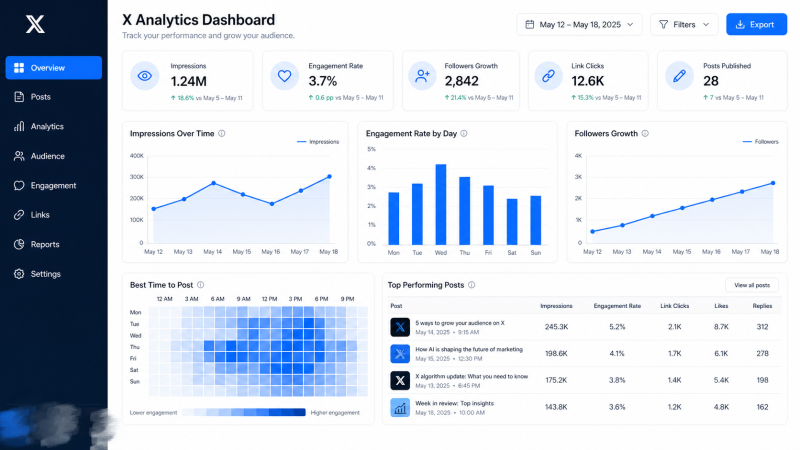
If your audience is mainly distributed in various countries, your posting schedule should follow your target market’s local time instead of your own.
For example, if most of your audience is in the U.S., it makes more sense to test weekday daytime and midday posting windows based on U.S. time zones rather than your own working hours.
Take similar types of content and publish them at different times over a period of 2–4 weeks. Then compare impressions, likes, replies, reposts, clicks, and other performance signals. Over time, you can narrow down the time windows that work best for your specific audience.
Posting time matters, but it is not the only thing that determines performance. If the content itself isn’t compelling, even a post published during peak hours may still underperform.
Besides timing, content quality and ongoing performance review are just as important.
On X, you should also pay attention to the following:
In other words, the best posting time can give you a better starting point, but what really determines how far your content can go is your overall content growth strategy .
If you’re testing posting times for a single account, you can still manage it manually with some patience. But if you’re running multiple X accounts, accounts across different regions, or large-scale posting-time tests, manual scheduling can quickly become difficult to manage.
At that point, it becomes more important to build a system around posting-time testing, account environment management, and execution workflows than simply remembering which day or hour performs best.
For example, you may need to:
For this kind of workflow, DuoPlus Cloud Phone is a more efficient way to handle the execution side of multi-account operations. When you’re managing multiple X accounts at the same time, the challenge is no longer just deciding when to post. It also becomes about how to switch between accounts efficiently, how to keep account environments separate, and how to reduce repetitive manual work.
DuoPlus helps teams manage multiple account environments from one dashboard, while also supporting automated workflows for repetitive tasks. This makes multi-account testing and day-to-day operations more efficient.
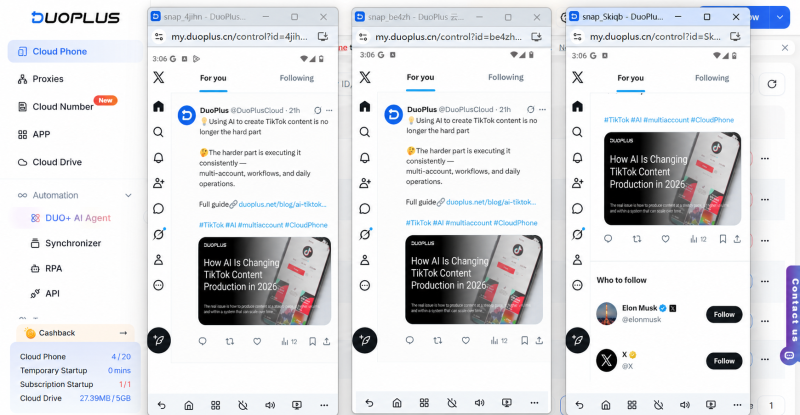
Once the number of accounts increases, your posting-time strategy also needs the right execution tools behind it.
If you’re just getting started on X, you can begin by testing the general high-activity windows — especially weekday daytime hours, with extra focus on Tuesday to Thursday.
But if you want to build a more stable and effective posting strategy, you should combine general recommendations with your own audience data, then keep testing and refining over time.
There is no fixed answer to the “best time to post”on X. It’s an ongoing optimization process.
Posting at the right time can absolutely help your content get seen more easily. But in the long run, what really drives performance is still content quality, consistency, and regular performance review.
Reddit is a community-driven social platform where users can join different Subreddits, publish posts, reply to …

Having trouble logging into Reddit is a common issue for both new and existing users. You may enter the correct username …

Meesho is more than just an online shopping platform. In addition to buying products, users can potentially earn money …
No need to purchase multiple real phones.
With DuoPlus, one person can operate numerous cloud phones and social media accounts from a single computer, driving traffic and boosting sales for you.