




Best Instagram Analytics Tools: 5 Tools to Track and Analyze Instagram Data
Instagram management is about more than likes and follower counts. For individual creators, brand accounts, and …
Learn the best time to post on Facebook in 2026, explore the latest industry benchmarks, understand what influences Facebook posting times, and discover how to build an effective Facebook posting strategy based on your audience. See how cloud phones can also simplify posting schedule tests across multiple Facebook Pages.

Get an AI-Powered Summary of This Article
One of the most common questions in Facebook marketing is: When is the best time to post on Facebook?
Every year, platforms like Buffer, Hootsuite, and Sprout Social analyze millions of Facebook posts to identify trends in Facebook posting times and user engagement. These reports provide valuable benchmarks that help marketers create an initial Facebook posting schedule and better understand when audiences are most active.
However, there isn't a single posting time that works for every Facebook Page.
Your audience's location, industry, time zone, content format, and user behavior all influence how your posts perform. The same publishing time can produce completely different results across different Pages. That's why successful brands don't rely solely on industry studies—they combine benchmark data with their own Facebook Insights to continuously refine their Facebook posting strategy.
In this guide, we'll review the latest research from leading social media platforms, discuss the factors that affect posting performance, and show you how to identify the best posting schedule for your own audience.
Several well-known social media platforms publish annual research on the best times to post on Facebook.
Companies such as Buffer, Hootsuite, Sprout Social, and SocialPilot analyze engagement data from thousands—or even millions—of Facebook Pages to identify when users are generally the most active. These reports offer valuable guidance, especially for businesses that are just starting to build their content calendar.
Below is a summary of their latest recommendations.
| Source | Recommended Posting Time | Key Findings |
|---|---|---|
| Buffer | Weekday mornings to noon | Engagement is generally hi gher on weekdays than we ekends, with mornings perf orming consistently well. |
| Hootsuite | Tuesday to Thursday mornin gs | Midweek mornings tend to generate stronger reach an d engagement. |
| Sprout Social | Monday through Thursday mornings | Weekday mornings remain one of the most active peri ods across Facebook. |
| SocialPilot | Tuesday and Wednesday m ornings | Recommends further opti mization based on industry and audience. |
Although the datasets and methodologies differ, these studies reveal several consistent patterns:
These benchmarks are particularly useful when creating your first Facebook posting schedule, but they shouldn't be treated as universal rules.
As your Facebook Page grows, your own audience data becomes far more valuable than industry averages.
Your niche, target market, audience demographics, time zones, and content format all influence performance.
For example, a B2B company targeting professionals in North America may achieve higher engagement during business hours, while an eCommerce brand focused on Southeast Asian consumers could see stronger results later in the evening. Likewise, Facebook Reels often follow different engagement patterns than image posts or link posts, since Reels rely more heavily on Facebook's recommendation algorithm.
For that reason, industry benchmarks should serve as a starting point—not the final answer.
After publishing consistently for a period of time, review your performance in Facebook Insights. Compare reach, engagement, clicks, and video performance across different publishing windows, then gradually adjust your Facebook posting strategy based on real audience behavior.
Over time, you'll develop a posting schedule that's tailored specifically to your audience rather than relying solely on general industry research.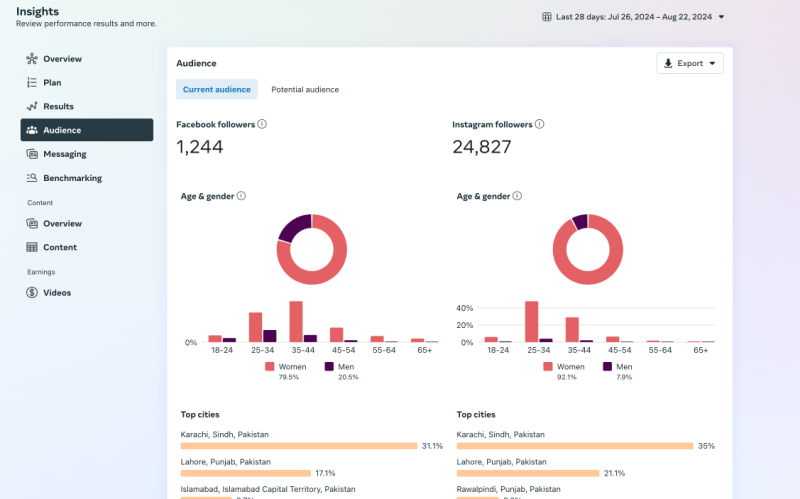
Industry research is a great starting point, but there is no universal Facebook posting schedule that works for every Page. The same posting time can generate completely different results depending on your audience, market, and content type.
Before finalizing your Facebook posting strategy, consider the following factors.
Facebook is a global platform, so audience activity varies significantly across countries and regions.
For example, users in North America, Europe, and Southeast Asia all browse Facebook at different times of the day. If you manage multiple regional Pages, scheduling posts according to each local time zone usually produces better results than publishing everything at the same time.
When creating a Facebook posting schedule, always prioritize your audience's local time instead of your own working hours.
Different audiences use Facebook differently.
For example:
Understanding who your audience is—and when they're most likely to scroll—is a key part of building an effective Facebook posting strategy.
Not every content format performs the same way.
For example:
Because of these differences, your ideal Facebook posting times may vary depending on the type of content you're publishing.
The "best" posting time also depends on what you're trying to achieve.
For example:
Rather than following a fixed timetable forever, continuously testing and refining your Facebook posting schedule will produce much more reliable long-term results.
Industry benchmarks provide an excellent starting point, but the most effective Facebook posting schedule is the one that's based on your own audience data. As your Facebook Page grows, you'll collect valuable performance insights that can help you continuously refine your Facebook posting strategy.
Instead of changing posting times randomly, build a structured testing process and optimize based on measurable results.
The easiest way to begin is by using industry research as your baseline.
Studies from Buffer, Hootsuite, Sprout Social, and SocialPilot all suggest that weekday mornings generally perform well, making them a good starting point for your first Facebook posting schedule.
Once your Page has accumulated enough content, open Facebook Insights and review historical performance.
Pay attention to metrics such as:
You may discover that your audience behaves differently from industry averages. For example, while benchmark reports recommend publishing in the morning, your followers may engage more during lunch breaks or in the evening.
Using both industry data and your own analytics allows you to create a more reliable Facebook posting strategy from the beginning.
After selecting several candidate posting times, compare them through controlled testing.
For example, you might test:
During the testing period, try to keep everything except the posting time consistent.
Best practices include:
If your Page has a large audience, you can publish different—but comparable—posts on the same day at different times. Smaller Pages may prefer alternating posting times across different days.
This systematic approach helps identify which Facebook posting times consistently deliver stronger performance.
Finding the best posting time isn't just about counting likes.
Instead, evaluate several performance indicators together.
Useful Facebook Insights metrics include:
Recording these metrics after each test makes it much easier to identify long-term trends rather than relying on the results of a single post.
Over time, you'll develop a Facebook posting schedule that's tailored specifically to your audience instead of relying solely on general industry recommendations.
Managing one Facebook Page is relatively straightforward.
However, testing posting schedules becomes much more complicated when you're responsible for multiple Pages across different countries and time zones.
Frequently logging in and out of different accounts, switching devices, and publishing at various local times can quickly become inefficient—and may even increase account security risks.
With DuoPlus Cloud Phone, each Facebook Page can run inside its own isolated Android environment with an independent network configuration. This allows teams to test different Facebook posting schedules across multiple regions simultaneously without constantly switching devices.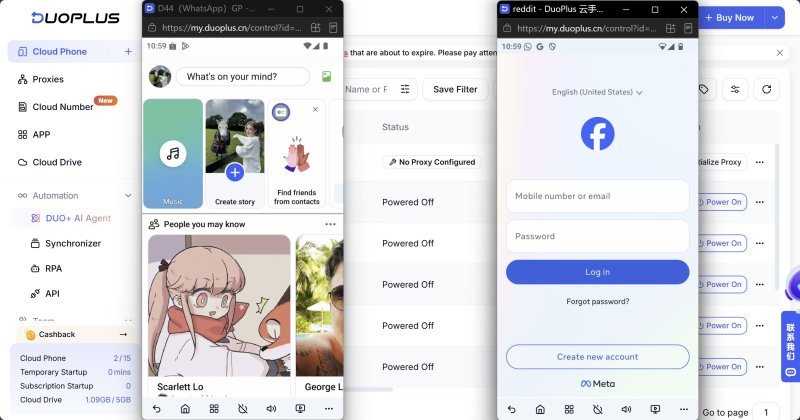
For teams running ongoing optimization campaigns, DuoPlus also provides automation capabilities:
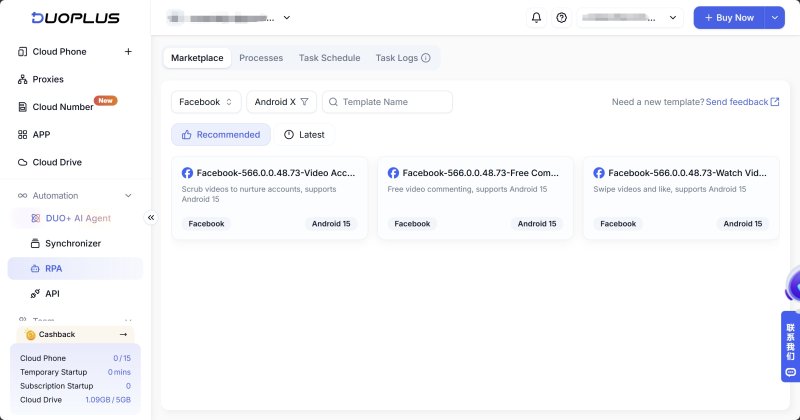
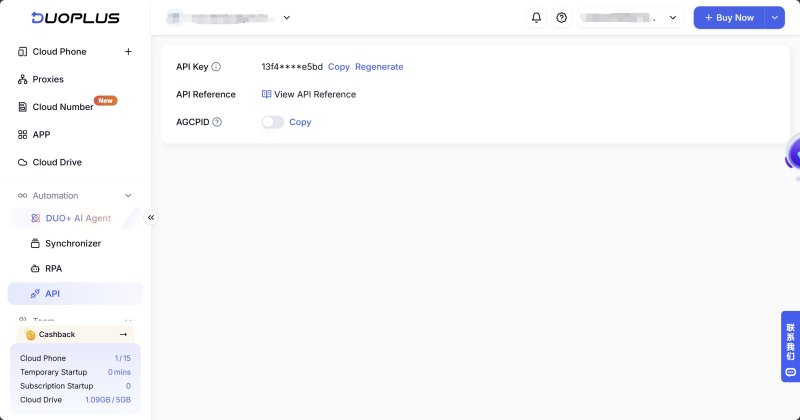
Whether you're optimizing one Page or coordinating dozens of regional accounts, combining cloud phones with a structured Facebook posting strategy helps standardize testing, reduce manual work, and generate more reliable data for future content planning.
There is no universal answer to the best time to post on Facebook.
Industry research can help you build an initial Facebook posting schedule and reduce trial and error, especially when launching a new Facebook Page. However, as your audience grows, your own performance data should become the primary driver of your Facebook posting strategy.
Regularly reviewing Facebook Insights, testing different Facebook posting times, and refining your publishing schedule based on real engagement data will help you develop a posting rhythm that fits your audience rather than relying solely on general benchmarks.
For teams managing multiple Pages across different countries, a standardized testing workflow becomes even more valuable. By combining cloud phones, multi-account management, and automation, you can streamline posting schedule experiments, simplify content publishing, and continuously optimize performance across different markets.
Most industry studies suggest that weekday mornings through midday tend to generate the highest engagement. However, the ideal Facebook posting times vary depending on your industry, audience, time zone, and content type. Use these benchmarks as a starting point, then refine your Facebook posting schedule based on your own analytics.
If you manage a Facebook Page, you can use Facebook Insights (Professional Dashboard) to review audience activity, reach, engagement, and other performance metrics. These insights are the best resource for optimizing your Facebook posting strategy over time.
Not usually.
Audience behavior differs across regions, so it's generally better to publish according to each market's local time zone. If you're managing Pages for the US, Europe, and Asia, creating separate Facebook posting schedules for each region will typically deliver more consistent results than using one universal timetable.
Yes.
Facebook Reels rely more heavily on Facebook's recommendation algorithm than standard posts, so their performance isn't always tied to the same posting windows. Testing different publishing times and comparing video views, watch time, and engagement can help identify the optimal schedule for your Reels content.
When managing multiple Facebook Pages, switching between devices and accounts can quickly become time-consuming.
With DuoPlus Cloud Phone, you can assign each Page to its own isolated Android environment with an independent network configuration. Combined with scheduled RPA automation and API integrations, teams can automate publishing, compare different Facebook posting schedules, and analyze performance across multiple markets from a centralized dashboard.
Instagram management is about more than likes and follower counts. For individual creators, brand accounts, and …

When creating YouTube videos, the script determines the video’s structure, pacing, and completeness. For creators who …

An Android app may work perfectly on one phone but behave differently on another. Differences in Android versions, …
No need to purchase multiple real phones.
With DuoPlus, one person can operate numerous cloud phones and social media accounts from a single computer, driving traffic and boosting sales for you.