




How to Use ADB with Cloud Phones: Common Android App Testing Scenarios and Methods
Android app testing often involves repeatedly installing apps, testing different versions, performing fixed operations, …
Compare the top 4 email delivery services for SaaS startups in 2026: Mailtrap, Mailgun, Twilio SendGrid, and Postmark. Learn about deliverability, pricing, and which provider fits your startup's growth stage.

Get an AI-Powered Summary of This Article
The best email delivery services for SaaS startups in 2026 are Mailtrap, Mailgun, Twilio SendGrid, and Postmark. Each handles email delivery differently, and choosing the wrong one can cost a lot of problems in the future.
This guide compares all four on what actually matters for early-stage and growth-stage SaaS: deliverability infrastructure, setup speed, startup-friendly pricing, and analytics that surface problems before users file support tickets.
An email delivery service is a dedicated platform that sends transactional and bulk email from your application with authentication (SPF, DKIM, DMARC), sender reputation management, delivery analytics, and bounce processing built in. Most of them have similar features, but they also differ:
| Provider | Stream Separation | Best for | Free tier | Starting price | Dedicated IP | G2 rating |
|---|---|---|---|---|---|---|
| Mailtrap | Built-in (default) | Deliverability and analytics | 4,000 emails/mo | $15/mo | Business plan ($85/mo) | 4.8/5 |
| Mailgun | Manual (IP pools) | Pre-send address validation | 100 emails/day | $15/mo | $59/mo add-on | 4.2/5 |
| Twilio SendGrid | Manual (IP pools / subusers) | Twilio ecosystem users | 100 emails/day (60-day trial) | $19.95/mo | Pro plan+ | 4.0/5 |
| Postmark | Built-in (Message Streams) | Delivery speed | 100-email developer trial | $15/mo | 300K+ sends only | 4.6/5 |
● Mailtrap is for SaaS startups where signup and onboarding deliverability is the top priority to get per-mailbox-provider analytics without add-ons from day one.
● Mailgun is for SaaS startups with high-volume signup flows to catch bad addresses before they generate a hard bounce.
● Twilio SendGrid is for SaaS startups already on Twilio or need to keep email, SMS, and voice activation under one billing account.
● Postmark is for time-sensitive activation flows to get magic links, two-factor codes, and verification emails delivered in seconds.
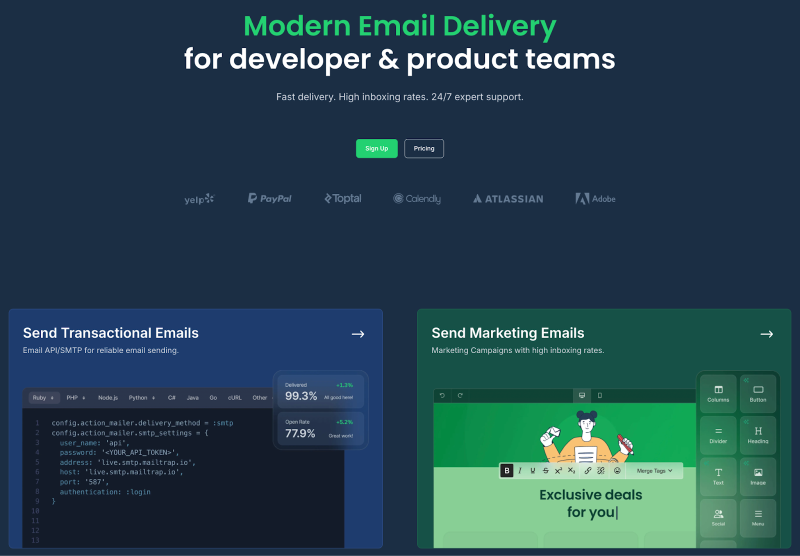
Mailtrap is an email delivery service for SaaS startups, developers, and product teams. The standout feature for SaaS startups is stream separation: transactional and bulk email run on isolated infrastructure with independent IP pools by default, so a bounce spike from a promotional campaign never touches your verification emails.
SPF, DKIM, and DMARC configure automatically once you add the DNS records. DKIM keys rotate every month. Analytics break performance down by mailbox provider, domain, stream, and category. Logs are retained for 30 days. Webhooks fire on all delivery events with 40 retries every five minutes.
Official SDKs cover Node.js, Ruby, PHP, Python, .NET, Elixir, and Java, plus 25+ framework snippets. Setup from account creation to first send takes about five minutes. Native integrations are available for Vercel and Supabase, and an MCP server connects it to AI coding tools including VS Code, Cursor, and Claude.
Pros:
● Transactional and bulk streams separated by default
● SPF, DKIM, and DMARC auto-configured; DKIM keys rotate monthly
● Per-mailbox-provider analytics included on all paid plans with no add-ons required
● Setup in about five minutes; official SDKs for 7 languages and 25+ framework snippets
● MCP server for AI coding tools (VS Code, Cursor, Claude)
Cons:
● Dedicated IP is only available on the Business and Enterprise plans
● Marketing automation depth is limited
Pricing: Free tier covers 4,000 emails per month. Basic starts at $15/month for 10,000 emails. Business is $85/month for 100,000 emails and includes a dedicated IP with automatic warmup, SSO, and 24/7 priority support. Enterprise starts at $750/month for up to 1.5 million emails.
Best for: SaaS developers and product teams who cannot afford to have a signup or verification email miss the inbox during trial onboarding.
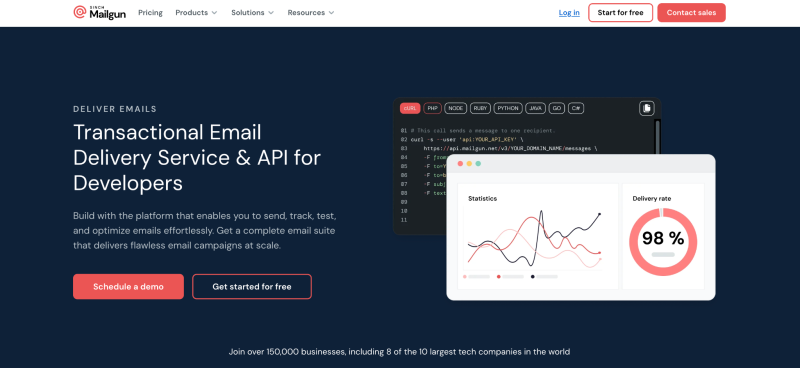
Mailgun is a developer-first email delivery service for SaaS with a built-in validation layer that catches bad addresses before they generate a hard bounce. Trial signups produce bad addresses at a meaningful rate: disposable inboxes, typos, and fake domains. Hard bounces damage sender reputation over time and suppress delivery for real users. Mailgun's validation API catches those addresses at the form submission stage, not after the fact.
SPF, DKIM, and DMARC require manual configuration through DNS. The RESTful API supports inbound email routing with regex parsing, batch sends of up to 1,000 recipients per call, and per-domain API keys for fine-grained access control in multi-tenant setups. Automatic bounce and spam complaint suppression is included on every plan.
Webhooks retry for 8 hours on failure. Log retention runs up to 30 days on the Scale plan. The base plan retains logs for only 5 days, the shortest of these four providers, which makes diagnosing onboarding issues harder when problems surface a week after they start.
Pros:
● Email validation API catches bad addresses before they bounce and damage sender reputation
● Per-domain API keys for multi-tenant SaaS setups
● Inbound email routing for reply-based workflows
● SOC 2 Type II and GDPR compliant
Cons:
● 5-day log retention on the base plan limits post-incident diagnosis
● Dedicated IPs cost $59/month extra, available from the Foundation plan
● Advanced analytics require the Optimize add-on and are not included by default
● Manual SPF, DKIM, and DMARC setup
Pricing: Free tier covers 100 emails per day. Basic starts at $15/month for 10,000 emails. Foundation is $35/month for 50,000 emails. Scale starts at $90/month for 100,000 emails. Dedicated IPs are $59/month. Overage runs $1.80 per 1,000 emails.
Best for: SaaS startups where signup quality is a concern and pre-send address validation is a core requirement, not a nice-to-have.
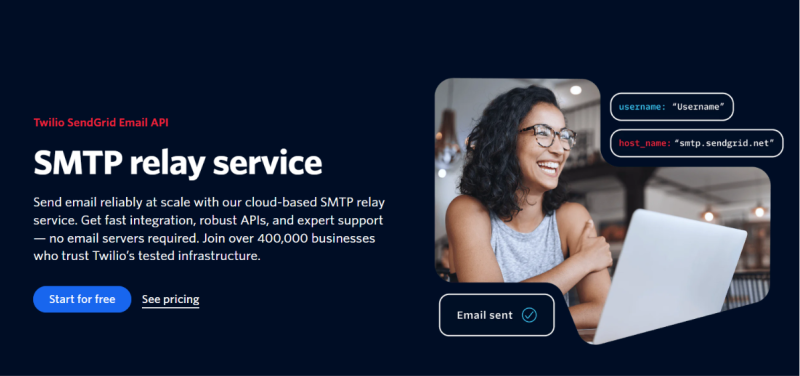
Twilio SendGrid is the most widely deployed email delivery service for SaaS in the market. Its PHP SDK has over 44 million installs on Packagist, which means most frameworks already have a community integration available. For teams where multiple engineers have used SendGrid before, ramp-up time on the email side is minimal.
The Twilio connection is the clearest differentiator for SaaS startups. If your product sends verification codes via SMS, uses voice as an activation fallback, or plans to add push notifications, SendGrid puts all of that under one vendor and one billing account.
Official SDKs cover Node.js, PHP, Python, Ruby, Java, Go, and C#. Dynamic templates with server-side Handlebars are a first-class feature for personalized onboarding sequences. Stream separation is not built in. Teams that need it approximate it through IP pools or subuser accounts, both of which require manual configuration. Event webhooks retry for 24 hours after failure. Activity logs retain for 30 days on paid plans. SOC 2 Type II and GDPR compliance are included.
Pros:
● Largest installed base with community integrations across most frameworks
● Twilio ecosystem integration (SMS, voice, and email under one account)
● SDK coverage across 7 languages including C#
● 24-hour webhook retry window
Cons:
● No native stream separation; requires manual IP pool or subuser configuration
● Free plan is a 60-day trial that expires, not a permanent free tier
● Starting price ($19.95/mo) is higher than the other three providers for equivalent volume
● Customer support response times are a recurring complaint in G2 reviews
Pricing: Free plan covers 100 emails per day for 60 days, then expires. Essentials starts at $19.95/month for 50,000 emails. Pro is $89.95/month for 100,000 emails. Premier is custom-priced.
Best for: SaaS startups already using Twilio for SMS or voice who want a single vendor for all activation channels.
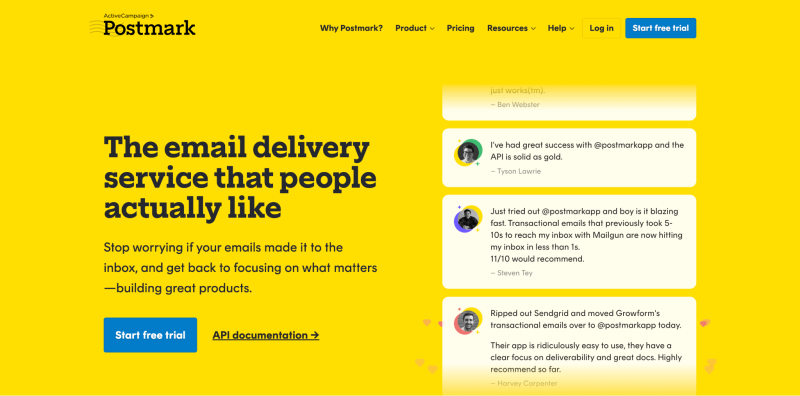
Postmark is an email delivery service for SaaS teams built around delivery speed. Magic-link logins, two-factor codes, and email verification gates have a short patience window. Users who wait more than 60 seconds for a verification email drop off at a measurable rate. Postmark is built to close that window.
The platform runs a strict account review before enabling live sending, which keeps the shared IP pool clean. Like Mailtrap, Postmark has separate streams at the infrastructure level, with each stream carrying its own IP reputation. A broadcast campaign cannot suppress your signup flow.
Official SDKs cover Node.js, PHP, Python, Ruby, .NET, Java, and Go. Log retention runs 45 days, the longest of these four providers. Every analytics and log feature is included on every plan with no feature gating by tier. Account review typically clears within one business day; setup runs 5 to 10 minutes after that.
Pros:
● Delivery speed is the core architecture goal, not a secondary feature
● 45-day log retention on all plans, no feature gating
● Message Streams separate traffic at the infrastructure level by default
● All analytics features included on every plan
Cons:
● No permanent free tier; only a 100-email developer trial
● Dedicated IPs require 300,000+ monthly sends
● Cost scales steeply at higher volumes ($60.50/mo at 50K, $138/mo at 125K)
● Account review adds one business day before live sending can begin
Pricing: Developer trial covers 100 emails. Paid plans start at $15/month for 10,000 emails. 50,000 emails cost $60.50/month. 125,000 emails cost $138/month. A dedicated IP adds $50/month and is only available at 300,000+ monthly sends.
Best for: SaaS startups where time-sensitive transactional emails, such as magic links, 2FA codes, and verification gates, directly gate user activation.
The right provider depends on where your startup is and what type of email failure would hurt most right now.
If you are pre-product-market-fit and optimizing for activation, deliverability on verification and welcome emails matters more than price. A signup email that lands in spam on day one teaches users to distrust your product before they experience it. Mailtrap's default stream separation and per-mailbox-provider analytics let you catch those problems early, before they affect enough users to suppress your trial metrics.
If your signup flow generates bad addresses at scale, pre-send validation pays for itself fast. Hard bounces from disposable inboxes, typos, and fake domains degrade sender reputation over time and suppress delivery for real users. Mailgun catches those at the form stage, before they reach your sending infrastructure.
If your team already runs on Twilio, SendGrid keeps vendor relationships simple. SMS verification, voice fallback, and email activation under one billing account is a real operational advantage for small engineering teams managing multiple tools.
If activation speed is the single most important factor, Postmark is built for exactly that use case. The strict account review process keeps the shared IP pool clean, which benefits every sender on the platform.
At early volumes (under 10,000 emails per month), Mailtrap's free tier of 4,000 emails and $15/month base plan give you room to grow without committing a budget. Postmark's lack of a permanent free tier is a disadvantage at this stage. Mailgun's 100-emails-per-day free tier works for development but is too low for even a small active user base.
At growth volumes (50,000 to 100,000 emails per month), pricing diverges. Mailgun at $90/month and Twilio SendGrid at $89.95/month are comparable. Mailtrap's Business plan at $85/month for 100,000 emails includes a dedicated IP with automatic warmup. Postmark reaches $138/month at 125,000 emails, the highest cost in this comparison at scale.
The best email delivery service for a SaaS startup is the one that protects your activation emails at the volume and stage you are at today. Mailtrap covers the most ground for startups that need deliverability and visibility from day one. Postmark is the right call when delivery speed is the constraint you cannot compromise on. Mailgun earns its place when pre-send validation is core to your signup flow. Twilio SendGrid makes sense when your stack already runs on Twilio and you want one vendor for all activation channels.
Whichever email delivery service for SaaS you choose, get SPF, DKIM, and DMARC configured before your first production send.
What is an email delivery service?
An email delivery service is a dedicated infrastructure platform that sends transactional and bulk email from your application with authentication (SPF, DKIM, DMARC), sender reputation management, delivery analytics, and bounce processing included. Unlike general-purpose SMTP servers, these platforms are built to reliably deliver high volumes of application-triggered email to inboxes at scale.
Which email delivery service is best for early-stage SaaS startups?
Mailtrap is the strongest starting point for early-stage SaaS startups. The free tier covers 4,000 emails per month, setup takes about five minutes, and stream separation protects deliverability of signup and verification emails without manual configuration. The Basic plan at $15/month is low enough for pre-revenue teams.
Do SaaS startups need a dedicated IP address?
Not at launch. Shared IPs from reputable providers handle most teams sending under 100,000 emails per month. A dedicated IP becomes relevant when volume is high enough to build and maintain a separate sender reputation. Below that threshold, a dedicated IP with no sending history actually hurts deliverability compared to a well-managed shared pool.
Android app testing often involves repeatedly installing apps, testing different versions, performing fixed operations, …

Instagram management is about more than likes and follower counts. For individual creators, brand accounts, and …

When creating YouTube videos, the script determines the video’s structure, pacing, and completeness. For creators who …
No need to purchase multiple real phones.
With DuoPlus, one person can operate numerous cloud phones and social media accounts from a single computer, driving traffic and boosting sales for you.