DuoPlus Cloud Phone vs. VMOS Cloud
Compare both cloud phone platforms across access experience, AI automation, proxy and IP, cloud numbers, SMS verification, and pricing.
- ARM-based cloud phone environments

- Web access and multi-platform clients

- AI Agent and automation

- Proxy IP and cloud numbers

- Long-term cost control

*Start with DuoPlus to test a complete cloud phone account operation workflow.
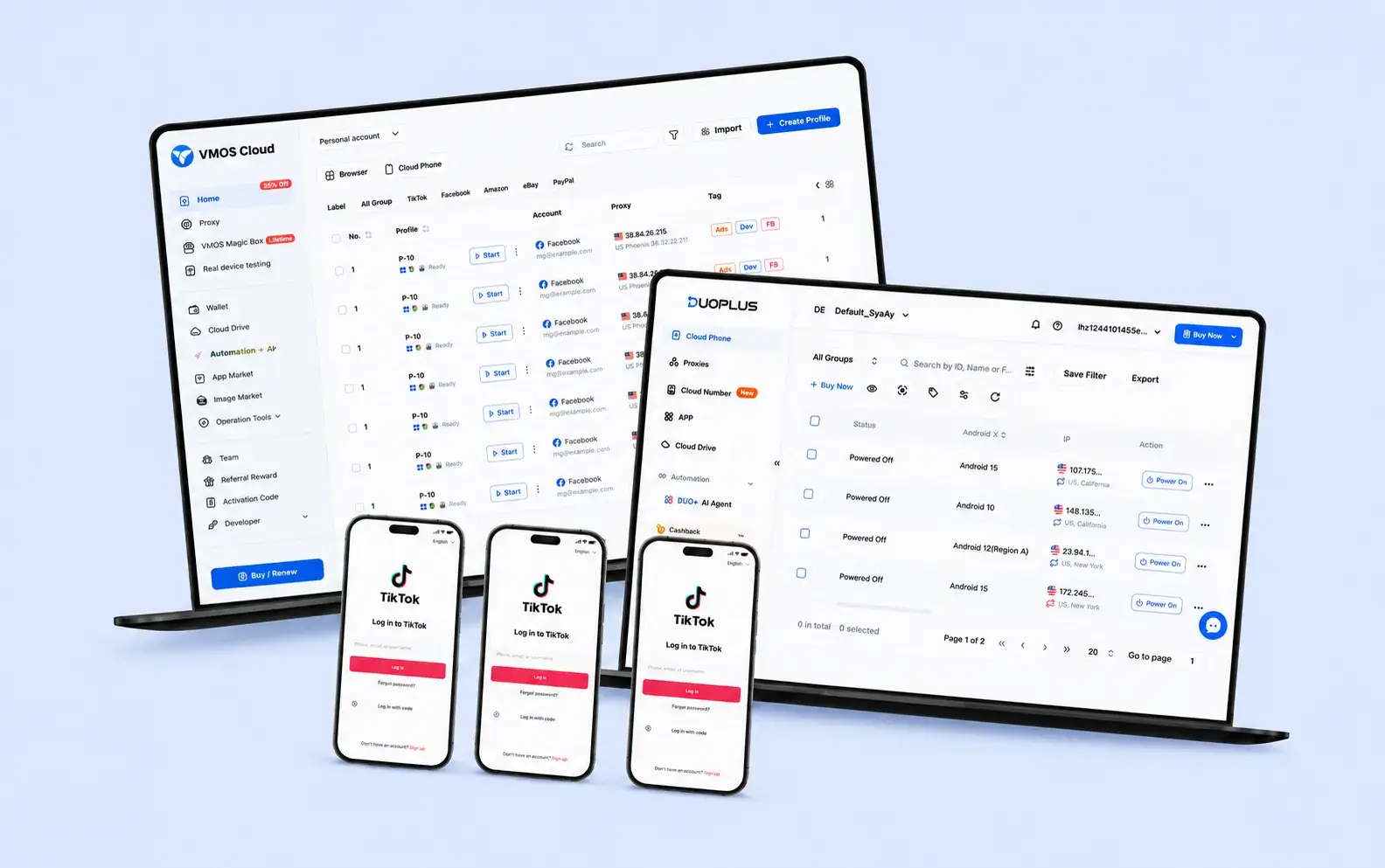
DuoPlus vs. VMOS Cloud Comparison Chart
A practical comparison for mobile multi-account management teams
 | VMOS Cloud | |
|---|---|---|
Free trial | Yes | Yes |
Company country | Singapore | China |
Real ARM cloud phones | Yes | Yes |
Cloud number support | Yes | Temporary SMS / number capability is available, but the risk is higher |
Online SMS verification | Yes | SMS-related services are available, but they are more suited to one-time code reception |
Independent device parameters | Yes | Yes |
Independent system environment | Yes | Yes |
Cloud phone operation sync | Yes | Yes |
Batch file push | Yes | Not highlighted as a core public selling point |
AI + RPA automation | Yes | Yes |
AI Agent cross-app automation | Yes | AI automation is available, but it leans more toward basic tasks and workflows |
Platform-specific RPA templates | Yes | Templates and no-code capabilities are available |
Third-party proxy integration | Yes | Yes |
Cloud number + cloud phone workflow | Yes | No |
Team collaboration / permissions | Yes | Yes |
Operation logs | Yes | Yes |
API | Yes | Yes |
Window sync | Yes | Yes |
Full web-based use | Yes | Web access is available, but the product experience is more client-oriented |
Why DuoPlus Fits Long-Term Multi-Account Teams
Connect Cloud Phones, SMS Verification, and Automation with DuoPlus
If your focus is long-term overseas account operations rather than short-term running or single-point automation, DuoPlus fits the daily workflow more naturally.
Access model
AI and automation
Proxy capability
SMS and verification
Pricing model
DuoPlus Fits Long-Term Account Operations Better
- Full browser-based operations for remote teams and cross-device work
- Cloud numbers for registration, login checks, 2FA, and long-term binding
- Pay-as-you-go startup plus monthly startup options for easier long-term budgeting
Why teams compare VMOS Cloud with DuoPlus
DuoPlus vs VMOS Cloud: which one is better for mobile multi-account management?
Many people searching for DuoPlus vs VMOS Cloud are not just comparing two cloud phone products. They are looking for a mobile multi-account management setup that actually fits their workflow.
If you only need a few cloud phones for short-term running, testing, or temporary tasks, VMOS Cloud has its place. But if your goal is long-term multi-account operations on platforms such as TikTok, Instagram, Facebook, and WhatsApp, the real questions are different: Are account environments isolated? Is registration and SMS verification smooth? Is account warming stable? Can teams run tasks in bulk? Can collaboration scale?
From that angle, DuoPlus is closer to a cloud phone system built for account matrix operations, while VMOS Cloud is closer to a broader cloud phone product that can be used in many scenarios. Both can work, but they are not solving the same problem.
VMOS Cloud vs DuoPlus: start with the product direction
Many teams compare VMOS Cloud and DuoPlus by looking at surface-level features: both have cloud phones, both mention automation, and both support proxies. But the day-to-day experience is shaped by who the product was built for.
VMOS Cloud's public product direction is broader. It is often associated with cloud phone access, running tasks, multiple clients, flexible billing, and general-purpose cloud phone scenarios. It can be used for social media account operations, but its public feature structure is not built entirely around long-term social media matrices.
DuoPlus is more clearly designed around overseas account matrix operations. Cloud phones, cloud numbers, SMS verification, operation sync, batch file push, AI Agent automation, RPA, team permissions, and operation logs all map more closely to the daily workflow of cross-border teams.
If you just need a usable cloud phone, VMOS Cloud is worth considering. If you need a system for long-term account operations, DuoPlus has a clearer direction.
Why DuoPlus is better suited to long-term account matrices
In multi-account operations, the main risk is not a lack of devices. It is unstable environments. When device parameters are unclear, environments are not isolated, and workflows are inconsistent, registration, login, account warming, and advertising all become harder to manage.
DuoPlus starts from real ARM cloud phones, independent system environments, and independent device parameters. That makes it better suited to long-term mobile multi-account management across TikTok, Instagram, Facebook, and similar platforms. For real account matrix teams, this is not a nice-to-have feature. It is the foundation.
VMOS Cloud also provides cloud phones and isolated environments, but its public positioning is more about device availability, client coverage, and flexible usage. Those strengths fit short-term tasks and general cloud phone scenarios, but they do not automatically make it better for long-term social media matrices.
Why social media teams often lean toward DuoPlus
Social media multi-account management is not a single action. It includes registration, SMS verification, login, account warming, publishing, interactions, collaboration, and ongoing maintenance. Every step can affect account stability later.
DuoPlus is stronger for teams because it brings cloud phones, cloud numbers, online SMS verification, and account verification workflows into the same system. Teams do not need to stitch together devices, numbers, codes, and automation tools from separate services. That reduces execution cost and makes account registration and maintenance easier to standardize.
VMOS Cloud can cover parts of this workflow, but its public positioning is still closer to general cloud phone access, basic automation, and flexible usage rather than a complete overseas social media account operation pipeline.
Automation and bulk execution
It is easy to assume that both products are similar because both mention AI, automation, templates, and RPA. For teams, the real question is whether automation can reliably support the daily business.
DuoPlus automation is closer to real account operations. Operation sync, batch file push, AI Agent workflows, and RPA templates are designed for bulk login, account maintenance, repeated actions, and multi-device execution.
VMOS Cloud also has AI and automation features. But based on its public feature structure, it leans more toward basic task automation and flexible workflows rather than making complex cross-app, multi-account, long-term operations the core execution scenario.
If you just want to try automation, VMOS Cloud can work. If you want automation to become part of daily operations, DuoPlus is the stronger fit.
Team collaboration
For many teams, the real problem is not whether a tool works for one person. It is whether many people can use it together without the workflow falling apart.
When accounts, devices, SMS verification, materials, permissions, and task records are spread across different places, collaboration cost rises quickly. DuoPlus is better suited to team-based matrix operations because it supports permissions, operation logs, device management, and team collaboration in one workflow.
VMOS Cloud also supports multi-user usage and device management. But if your focus is long-term account maintenance, repeat verification, bulk execution, and unified workflow control, DuoPlus is organized more naturally around how social media matrix teams actually work.
Final verdict: DuoPlus or VMOS Cloud?
If you need short-term flexible use, fast setup, broad client coverage, built-in proxies, and usage-based billing, VMOS Cloud can still be an option.
But if you are building long-term mobile multi-account management and want cloud phones, cloud numbers, SMS verification, AI Agent automation, RPA, bulk execution, and team collaboration in one system, DuoPlus is the better choice.
VMOS Cloud can meet the need to "use a cloud phone." DuoPlus is better for teams that need to run a real account operation business.



Growth Operations Lead
Social Media Operations Manager
Affiliate Marketer